

Friday, 25th January, 2013
Lose-win situation

For a few weeks the lead rumour in the council has centred around a prominent member of the IPPG who’s been making noises that he intends to resign from the group to join Labour.
It hasn’t been a closely-guarded secret, and during this week the volume of these noises got progressively louder. So close is the member claimed to have come to jumping into the red that he’s even said to have had his resignation letter on standby in his top pocket.
A meeting with the leader of the council late this afternoon appears to have temporarily smoothed things over, and the possibility of a rebellion – and the Labour party – is left hanging in suspense.
Though not quite as clear, the other half of: either the same, or a different story, is beginning to emerge.
The IPPG top brass would have you believe that some councillors are in fact stumbling over each other to sign-up. It’s scarcely believable, I know, but this story has more legs than might first be realised. The key to understanding this is the availability of seats on the National Park, and the extra money (leverage) they give the council leader to attract fresh meat or maintain existing group members.
This system of patronage is a juggling act and forms the backbone of the IPPG’s constitution. It was touched upon in The Party Files Pt. 1 and is perhaps best summed up by the IPPG’s electoral strategist, who, in one document I published, advised that: “keeping all the troops happy…” is a “…difficult job.”
A seat on the National Park comes with a circa £3k Special Responsibility Allowance. Those members of the council who already receive an SRA – either by serving as a committee chair, cabinet members, council chair and vice-chair – are ineligible to receive another, so appointing an existing SRA-holder to the National Park effectively wastes a pound seat on the SRA gravy train.
There are two ‘white elephant’ or ‘toll-free’ seats on the National Park, to which the leader has appointed executive members already in receipt of an SRA. It is suspected, though not confirmed, that Cllr. Rob Lewis (cabinet member for planning and highways matters) is to step down from the National Park, generating a new SRA in financial terms.
The second white elephant on the National Park is a seat currently held by the council chairman, and is also suspected to be re-allocated under this strategic reconciliation of SRAs. Just who might be lined up to fill these potential new vacancies is anybody’s guess, possibly current troops or maybe new recruits. There are also three former-IPPG councillors knocking about, and it would be reckless to rule any one of them out.
In the Dock
Word has reached me that an internal investigation has been requested by a Pembroke Dock county councillor into the handling of two (possibly more) planning applications in the town for houses of multiple occupancy. Applications for HMOs have been cropping up in and around the Pembroke Dock area for a while, and are not uncommon for buildings which have previously received grant funding.
A retrospective application for a HMO in Pembroke Dock was on the agenda at the most recent planning committee, on 8th January. Despite numerous written submissions and mountains of documentary evidence available to the council from the various emergency services outlining a highly negative impact since the unauthorised works had been carried out, it was recommended by officers for approval.
A humorous second-hand account of the meeting and how it panned out has been covered over on that other website. The application gathered a groundswell of opposition from members of the public, many of which have previously quizzed the council on the topic of potential enforcement action. A large number attended the meeting and provided pantomime hisses and boos to make for a meeting sure to go down in the hall of fame.
The will to carry out enforcement in Pembrokeshire, or quite how difficult it is to commence, is a related but separate issue. Even though it was soundly beaten when it came to the vote, how this application ever came to be recommended for approval in the first place remains very unclear.
Urgent matter
For the first time in a decade, a meeting of the council’s urgency committee will be held on Thursday to discuss the government’s scrapping of the council tax benefits scheme.
Consisting of six members, the remit of the urgency committee is: “…to deal with urgent business in relation to Council functions where a decision cannot wait for the next available meeting of the Council or any of its Committees exercising plenary powers.”
It’s a bit of a nonentity as far as council committees go, even though, like cabinet, it’s counted as an “Executive Committee.” Due to its nature, the committee has no set frequency but instead is hastily arranged in the aftermath of some disaster or unanticipated scenario.
One particular unforeseen event in the council’s history which required large unbudgeted expenditure was the collapse of the cliff and part of the road at St. Bride’s Hill, in Saundersfoot.
Before I thumbed through the agenda I was convinced that Thursday’s urgency meeting had been convened to discuss the collapse of the IPPG. If today’s other rumours are to be believed, and the IPPG performs the miracle of bouncing back from a triple dip, then George Osborne take note – there may be hope for the UK economy yet.
Have you say
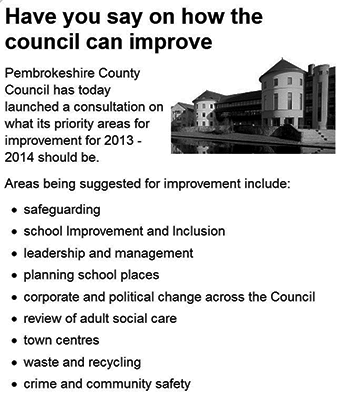 The council has launched a public consultation to identify its “priority areas” for improvement in 2013-14.
Recognising the recent publication of the Estyn and Wales Audit Office reports, three of the nine bullet-points suggested for improvement include safeguarding, leadership and management, and corporate and political change across the council.
The pedant within me suggests a practical consideration for improvement would be to proof-read. The announcement of this consultation on the council’s website invites members of the public to: “Have you say on how the council can improve.”
9 Comments...
Have your say...
 Check out and 'like' my Facebook page ↴
Recent posts…


Jacob, you seem to be hinting that National Park seats, and the allowances that go with them, might be used as bargaining chips in some game of political poker.
If such manoeuvres are underway, they are surely designed to correct the current 6-1 imbalance in favour of the north of the county among IPPG members serving on the NP authority.
Shame on you for suggesting that any such changes might be motivated by something other than the public interest!
Outrageous comments. Questioning the integrity of P.I.G. plus (just) ruling group in Pembrokeshire. No wonder the boundary commission is considering abolishing rogue wards.
Does the leader “appoint” NP members, or, recommend appointments to Council for formal approval?
If the former, is it within the power of the council to remove this, presumably delegated, authority from the Leader by amending the Constitution?
Representation of the people in a democracy (!) would suggest that such members should be drawn from the PCC members representing communities on the NPA.
I have just seen the required verification – must get the calculator out!
With one of the highest paid Chief Executives in Wales and the Estyn and WAO reports, they seek the public’s advice on how they can improve! There is no hope.
Following all these failings and shortcomings, I cannot understand why there has been no call for the most highly paid Council Chief Executive in Wales (£195,000 plus perks = 1 Prime Minister + 3 police constables) to resign…
Mike – You must have further information to share with my readers than I’ve included in ‘Lose-win situation.’ If you aren’t merely speculating and what you say is true – that these fresh NP seats will be ring-fenced for south county members – then the guessing game would be narrowed down somewhat.
John – The council’s seats on the National Park are apportioned to groups under the political balance rules. The leaders of the parties are free to dish them among their mercenaries, whilst unaffiliated members are appointed by full council.
At the time of typing the allocations are: IPPG – 7, Labour – 2, Plaid Cymru – 1, unaffiliated – 2.
Pure speculation on my part.
I was merely suggesting a rationale (or should that be rationalisation) should such a situation come about.
In the original constitution, the power to make appointments to outside bodies (including school governors) was delegated to Cabinet. At its very first meeting, Cabinet further delegated this power to the Leader.
The council does have the power to modify or recall such powers.
Let’s go back one stage further. Under the terms of the Model Constitution issued by WAG, Councils were given the local discretion to appoint the leader and members of the Cabinet OR appoint the leader.
In 2001/2, PCC chose to appoint the Leader, with the power to appoint “his” cabinet. Consequently we end up with the unedifying spectacle of the Leader trying to attract members to his group, by, it would appear, any means.
The previous Leader, stung by external pressure to improve the Council’s Corporate Governance arrangements, got Council to approve a fundamental review of the Council’s Constitution. As far as I am aware, this has largely been ignored, being reduced to a few suggestions put forward by members and necessary add ons arising from the new LG Measure.
Why hasn’t the fundamental review been carried out, going back to the terms of the Model Constitution and the many local choice options available to the council? Is there some resistance to this?
It seems that “going up the park,” in Pembrokeshire, is not just a euphemism for prostitution.