
Cllr. Dennison’s misconduct lands record sanction
Monday, 8th June, 2026
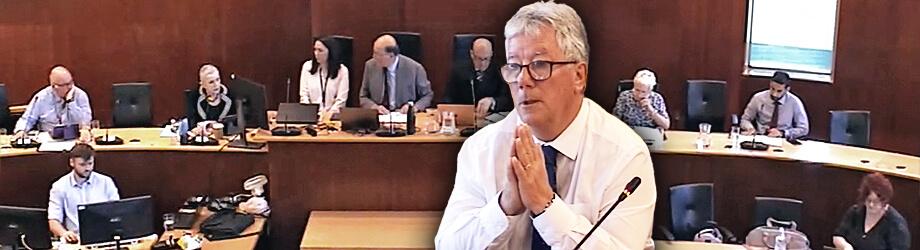
COUNCILLOR ALAN DENNISON’S DISCIPLINARY HAS ATTRACTED THE STIFFEST SENTENCE EVER HANDED DOWN BY PEMBROKESHIRE COUNTY COUNCIL’S STANDARDS COMMITTEE.
The Milford Haven member has landed a four-month suspension from office for abusing his elected position to interfere in his mate’s planning application, despite having clear and wide prejudicial interests.
The planning application, submitted by Mr. Lee Bridges, attempted to regularise illegal development activity at Bridges’ business, of which Cllr. Dennison had been a financial investor and served as company director.
Dennison’s actions constituted a series of flagrant breaches of the elected members’ code of conduct, against “very clear advice” according to councillor standards watchdog the Public Services Ombudsman for Wales.
The ruling finds Dennison exacerbated his breaches by his: ‘blatant disregard’ of the firm legal advice, blaming of others ‘unfairly,’ continued refusal to accept wrongdoing and ongoing denial of the facts in the face of clear evidence.
In a blitz of social media postings defiant Dennison claims he intends to appeal – continuing the tone he set throughout his standards appearance, which I’ve sketched below.
I’ve requested to see Dennison’s case evidence – and I understand he’s demanding it be made public – but the council is legally unable to publish until his appeal avenues have been exhausted.
Cllr. Dennison, first elected to the council in 2022 as an independent candidate, is desperate to paint my involvement in this case as some form of political witch hunt.
I’ve previously exposed, on this blog, his persistent bullying against a female councillor – and his bungled efforts to hide his tracks when smearing her online.
He had attempted to post his targeted comments anonymously. I exposed how his pseudonymous account had previously been titled “Alan Dennison – Senedd Candidate for Reform UK – Preseli Pembrokeshire,” for his 2021 deposit-losing Cardiff Bay election campaign. He and the party since split.
Dennison’s casual misogyny has also been well covered in the local media – last year publicly calling on Wales’ erstwhile first minister, Eluned Morgan, to: “just shut up, woman.”
My involvement in exposing Dennison’s misconduct in this planning case, and his so-far private rebuttals to the ombudsman against my involvement, will be shown in the evidence.
In my capacity as PCC’s cabinet member for planning, which I still hold, I had pointed out to senior council officers how Cllr. Dennison had a clear vested interest in this case he was meddling in – a conflict so severe that he was incapable of judging the public interest, appearing to serve private ends.
I based my suspicions over Cllr. Dennison’s conduct entirely on information within the public domain, as did the late Cllr. Mike Stoddart, who also raised concerns.
The standards committee proceedings heard how Cllr. Dennison was well warned, but ploughed on regardless.
Cllr. Dennison still denies he did anything wrong. Many of his supporters are downplaying its seriousness, including sitting councillors held to the same standards.
Some maintain the pretence of not understanding what Cllr. Dennison did wrong, that he’s been hard done by, or even the subject of a conspiracy. Such claims would be startling if they weren’t dishonest.
I haven’t seen the case files, which are contained within private appendices lettered A-E, but I do know that the highest page number referred to during the standards hearing was 403.
On publication these records will detail how Cllr. Dennison abused his elected position whilst listening to nobody who said he shouldn’t, and rubbishing anyone who thinks or advises him otherwise.
But there’s already got plenty to go on.
One of the key findings was surely how Cllr. Dennison acted “as an advocate and championing the application submitted by Mr. Bridges.”
That is not public service – it is using your public position to do favours.
How we got here…
Cllr. Alan Dennison’s close friend and business colleague, Mr. Lee Bridges, had conducted illegal development work at his business, a wedding and events venue. It was subject to a planning enforcement notice.
Bridges’ firm, Imperial Hall Limited of which Cllr. Dennison had served as company director and financial investor, operated out of the 19th century Masonic Hall – the listed building on Milford Haven’s Hamilton Terrace.
The premises is owned by the Freemasons, of which Dennison is a member and for whom he held office, including as secretary and director of its property holding company.
In December 2023 Bridges submitted a retrospective planning application which, if approved, would have overcome the enforcement notice, regularising his development breaches.
Whilst his plans were in the system, a notification was submitted to Companies House on 1st May, 2024, of Cllr. Dennison’s termination as company director.
This notification had been backdated to 4th August, 2023 – a point pre-dating the submission of the planning application, which was ultimately refused on 9th October, 2024, by planning officers under delegated powers.
Three weeks to the day later, Bridges resubmitted practically a carbon copy to the planners. Cllr. Dennison then used his elected position to intervene.
He invoked a formal council process on his friend’s planning application, attempting to remove planning officers’ power to determine it, and instead to put it into the hands of councillors on the planning committee, of which he is a member.
Dennison had been advised by the council’s legal and ethics chief – the monitoring officer – that he should have no involvement in the application, or efforts to send it to the planning committee, due to his clear conflicts of interest. He told her that he would withdraw his referral request, but went back on his word.
Cllr. Dennison still maintains that the extent of his vested interest in his friend’s plight should only curtail his involvement in making a decision on the application should it reach him at the planning committee.
Disregarding the monitoring officer’s advice, he pushed ahead, his formal motion to divert the application to the planning committee was heard by a panel meeting which Dennison and Bridges attended.
Members of the planning delegation panel raised concerns at the unprecedented nature of what had gone on. The late Cllr. Mike Stoddart referred to how, as of the morning of the meeting, Cllr. Dennison’s statutory declaration of interests on PCC’s website recorded he was an “employee” of “Imperial Hall Limited.”
The panel declined to refer it to the planning committee. The retrospective planning application was subsequently refused by planning officers under delegated powers.
Mr. Bridges appealed. This was turned down by the Welsh Government’s independent inspectors. The remedial works have since been undertaken and the enforcement notice complied with.
The disciplinary hearing like no other…
The stray street dogs of Sri Lanka will lament the four-month loss of their largesse from this corner of west Wales.*
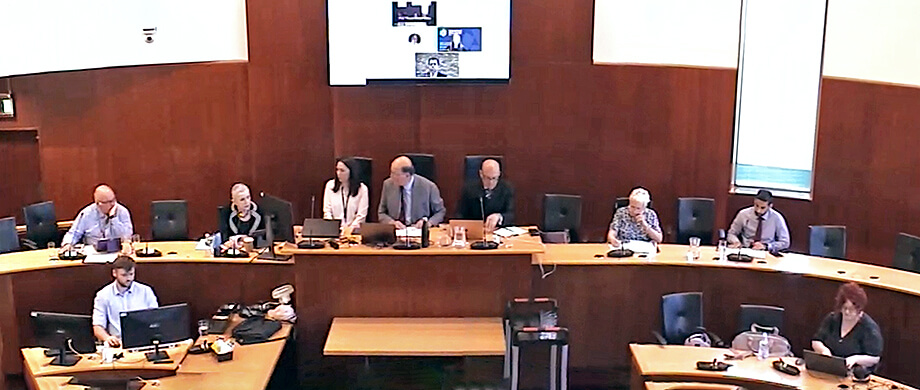
Pembrokeshire County Council’s standards committee has handed down its stiffest sentence yet, for an involved case of councillor misconduct the likes of which we haven’t seen for years.
As justice ran its course in the main council chamber, and staff all over the building were glued to the webcast, early indications suggest that Tuesday, 26th May, 2026 was both the most and least productive day in County Hall’s history.
If you haven’t seen the webcast recording, you owe it to yourself. You won’t find anything better on the telly.
It was early on, and Cllr. Alan Dennison was tangling with the vice-chair, Mr. David Parsons, in a way which wasn’t obviously helpful to his cause.
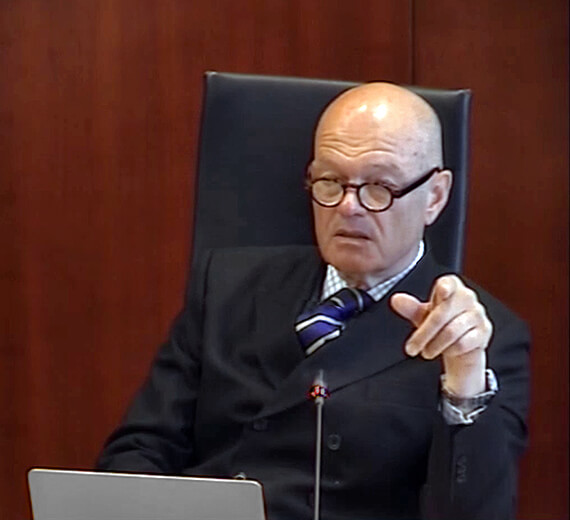
Vice-chair, Mr. David Parsons
Here Dennison was acting less the Freemason, more Perry Mason.
Things were going nowhere but the well-suited Parsons – a black double-breasted number, befitting this retired judge – tackled Dennison’s hair-splitting head on:
Vice-chair: “So are you saying that your Masonic meetings are in a different building?”
Dennison: “They’re in a different named building, yes, it’s held in the Masonic Hall.”
Vice-chair: “Well, it’s a matter of semantics, isn’t it?”
A lesser jurist would have folded.
“What is the relevance?” asked Mr. Parsons, Cllr. Dennison: “Nobody’s taking any point of my correction.”
If Dennison had a wider point, it sank without a trace minutes later, when the same sentiment – in identical words – was being made by our man in the dock: “it’s irrelevant, that’s just semantics.”
Finally, here was something they could both agree on.
To understand why Dennison would get down in the weeds on such inanity, it pays to consider how much thornier he’d have found nit-picking the case’s other undisputed evidence.
The depth of Dennison’s inveiglement with his chum, the retrospective planning applicant, did not hinge on the coterminosity of his Masonic lodge’s roof.
The committee heard how the Dennison and Bridges families’ links included a fortnight’s jolly to Mexico, and godmothership to the councillor’s grandchild.
But the whiffs of sleaze were supercharged to a reek when the committee heard how Dennison had given Bridges a pandemic-era loan to save his ailing enterprise. Bridges says: “I didn’t know him that well at that time,” and “I will always certainly feel friendship towards him for the help that he gave us.”
This revelation led to the unspoken prospect that Bridges’ illegal development activity at the site took place on Dennison’s dollar.
In exchange for this unspecified loan (said to have been long repaid) Bridges gave Dennison an unremunerated directorship of his company (since relinquished) “as a form of gratitude for his assistance.”
Cllr. Dennison now disputed what he had previously not disputed – even at one point saying with a straight face: “I’ve disputed the disputed facts, I’ve disputed the undisputed facts.”
Chairman Mr. Nick Watt reminded him: “They are undisputed facts. You did not dispute them until two days ago. In this procedure they have been accepted, and when this committee met on the 17th of February to consider the ombudsman’s report, they were forwarded to you. Alright?”
Dennison: “Could I ask then why my version of the undisputed facts were not allowed to progress, and yet the ombudsman’s were?”
Chair: “You agreed to them as undisputed facts months before,” later adding: “You were given an opportunity some months before to register objections to those matters of fact, and you did not.”
Judge Judy would have had palpitations.
But perhaps Dennison’s greatest gift was his last-minute application to introduce two witnesses, both for evidentiary and character testimony purposes.
Ringmaster Dennison pulled on the gold rope. The velvet curtains opened. There on the stage stood his colleague and former group leader Cllr. Huw Murphy, and the planning applicant himself, Mr. Lee Bridges.
This was the very first decision the committee had to make – should the accused’s late request be allowed, especially in the absence of any prior witness statements from the duo, as required?
Mr. Watt wasn’t alone in wondering: “what relevance Cllr. Murphy’s evidence is going to bring.”
The ombudsman’s barrister said how: “the ombudsman simply questions procedurally whether it’s appropriate to continue without witness statements in advance, and secondly, whether these are relevant witnesses to the disputed facts that this committee is going to need to determine.”
“Please, in the name of all that’s holy, we beg of you. Allow them both to speak,” screamed webcast viewers at their screens.
Our prayers were answered. An exception was made. And now, the circus was truly in town.
There’s a rumour that tactics were in play by the defendant in respect of his witness roster. That Dennison gambled on a horseman Huw appearance as part of an effort to make himself look smart.
What shock! Horror! Dennison must have felt, on seeing Murphy step down from his carriage at County Hall, wearing a suit and tie for the first time in his life.
One suspects Murphy’s end of the bargain was: “as long as you let me say whatever I want to, Alan.” This, another gamble, which backfired spectacularly.
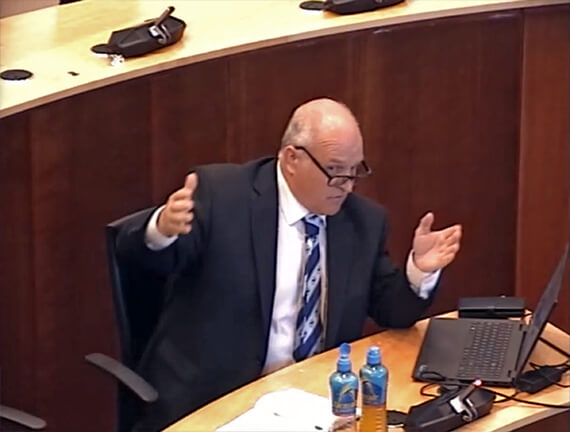
Cllr. Huw Murphy
Dennison’s just like me, Murphy said – “Marmite – some like him, some don’t,” relishing in informing the committee: “I have no interest in being popular.”
Many have noticed.
Murphy (a former cop – but never mentions it) rued controversial Al’s conduct proceedings and “unwarranted comments that had no reflection on his ability as a councillor.”
There wasn’t a dry eye in the house.
It’s tough to give a flavour of the meandering flannel Murphy treated us to in his attempts to refloat his pal.
Yet if I told you Dennison’s wingman Murphy invoked both “Margaret Thatcher” and “Denis Healey” in his contributions you wouldn’t believe me, even though I’m telling you he did.
Murphy and Dennison also claimed that yours truly and the late author of that other website, Cllr. Mike Stoddart, were the reason Dennison was in all this trouble.
Despite disregarding authoritative legal advice, we were to blame according to Dennison: “it was only due to the fact that two individuals, Cllr. Williams and Cllr. Stoddart, raised objections to this. And there are underlying reasons why this came about, and it has nothing to do with the planning application per se.”
Their wild conspiracy theory would make tin-hatters blush. It goes something like: us blogging councillors were miffed because when Alan joined Huw’s ‘independent’ party-that’s-not-a-party, we no longer got to sit near Alan in the council chamber, losing access to his wise counsel.
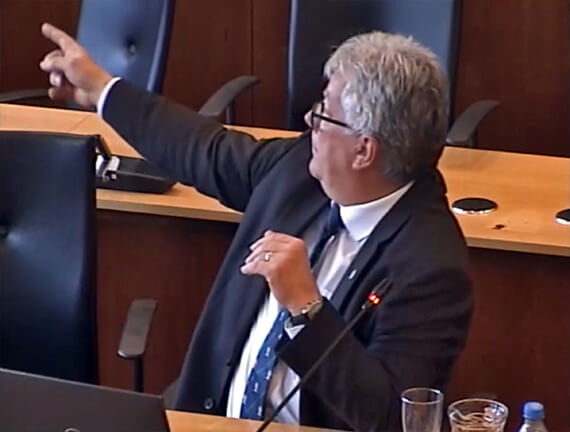 This seating arrangement was described as the “gang of three” by Dennison who, pointing over his shoulder, explained: “I sat next to them on the end of the chamber, there.”
As Huw put it: “social media comments from certain councillors made it very clear they were very unhappy with his decision of his own free will to sit in a particular group in a chamber that did not align where they sat.”
Tactics had been on display by Dennison from the meeting’s start. Deputy monitoring officer, Ffion Williams, was standing in for the monitoring officer, Mrs. Rhian Young, who had recused herself owing to her prior advice to Cllr. Dennison against his wrongdoing.
Chair: “Cllr. Dennison, any other preliminary procedural issues you wish to raise?”
Dennison: “Yeah, um, just one, one slight query, chair. If I could ask, um, Ffion, I think you say you’re legally advising the committee. Who is your immediate line manager?”
Legal adviser: “Rhian Young.”
Dennison: “So Rhian Young, whose statement is being utilised for the purposes of today’s committee, is your line manager, and yet you’re legally advising the committee. I feel that there possibly, to the public that’s listening, could be a perception that there’s an interest there, but I’ll, I’ll, I’ll just leave it at that.”
Far from being clever, this was rake-stepping on a biblical scale.
It revealed that Dennison does indeed possess the awareness to consider the public’s perception of public servants’ potential ethical conflicts.
Just not when it involves himself and his mate’s planning application.
As an adviser to the committee, this officer wasn’t sitting in Dennison’s judgment, but this interlude may have helped committee members see through Dennison’s other claims.
Chiefly the wacko idea that, even though he’d drafted and signed the relevant panel referral form to help his friend, he couldn’t possibly be on the hook for it.
His reasoning? “I’d signed the document in the name of Terry Davies, Cllr. Terry Davies, PP Terry Davies.”
Dennison expected them to believe: “that form was signed and owned by the principal, which is Cllr. Terry Davies, not me. So the content does not belong to me,” and: “that to me absolves any personal prejudicial interest because the name on that form belonged to Terry Davies.”
The committee members weren’t going for any of it.
Their first finding was on whether Dennison had a personal and prejudicial interest in the matter – if the answer was no, the action would conclude.
The ombudsman’s case was presented by barrister, Mr. David Gardner.
Learnèd counsel felt no need to be in the same room – running rings around Dennison through a webcam in another country.
Though dry and uneventful, this was the making of the case.
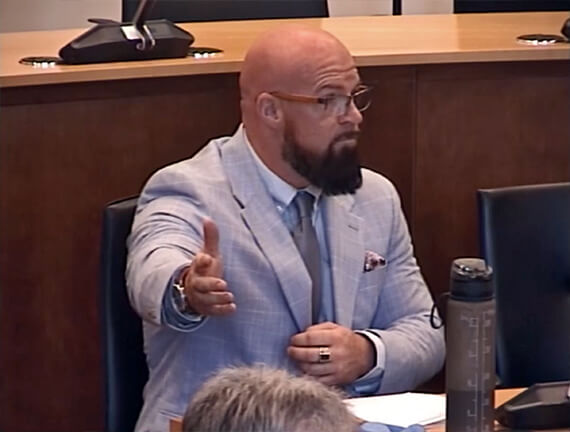
Mr. Lee Bridges
However aside from any links he had to Mr. Bridges and his company, the very existence of the enforcement notice was another strong reason why Cllr. Dennison should have steered well clear, as explained by Mr Gardner: “he was linked to the planning situation at Imperial Hall, not only having been a director, but also having had involvement as secretary of the Masonic Hall company, a company which owned the land which was subject to an enforcement notice.”
Mr. Gardner detailed – using Mr. Bridges’ own evidence – how high the stakes were for him and by association Cllr. Dennison:
“The planning applicant had made clear in an email that was sent to the council that the council’s proposals that he move the glass balustrade back by some four feet presented insurmountable problems, funds which he simply did not have, and repercussions which could lead to the closure of the business, the loss of fifteen full-time and part-time jobs, and the planning applicant said that the matter had taken a profound toll on him and his wife, both financially and emotionally.”
“That’s an email from the planning applicant setting out the obvious financial and personal interest that the planning applicant had in the application. The ombudsman, therefore, concludes that those circumstances show that the decision upon the matter was likely to affect the well-being or financial position of the planning applicant, and therefore the member had a personal interest by virtue of his close personal association with the planning applicant. Members of the committee, the code is quite clear that members must, in all matters, consider if they personally have an interest.”
It all served to underline how helpful, or otherwise, was Cllr. Dennison’s choice to wheel out Mr. Bridges to the stand.
Following deliberations the committee found Cllr. Dennison possessed a personal and prejudicial interest.
The chair explained the personal interest wasn’t just based on the councillor’s “close personal association with Mr. Bridges” but also because “the matter would have had a considerable impact on the wellbeing and financial position of Mr. Bridges.” On prejudicial:
“We conclude that Cllr. Dennison did have a prejudicial interest, based on his previous directorship of Imperial Hall and his awareness of the planning application history, his previous appointment as secretary of the Masonic Hall company, and his involvement as such in the planning enforcement investigations, his ongoing membership of the Masonic lodge and shareholding, albeit small, in the Masonic Hall company. And the fact that he and his wife and the planning applicant and his wife were friends and had been on holiday abroad together.
Additionally, we have considered what the public perception of Cllr. Dennison’s drafting and signing on a PP basis for Cllr. Davies of the motion to refer to the planning delegation panel. And we have decided that any member of the public in possession of those facts would reasonably conclude on balance of probabilities that he did so as an advocate and championing the applications submitted by Mr. Bridges. And those are our findings of fact.”
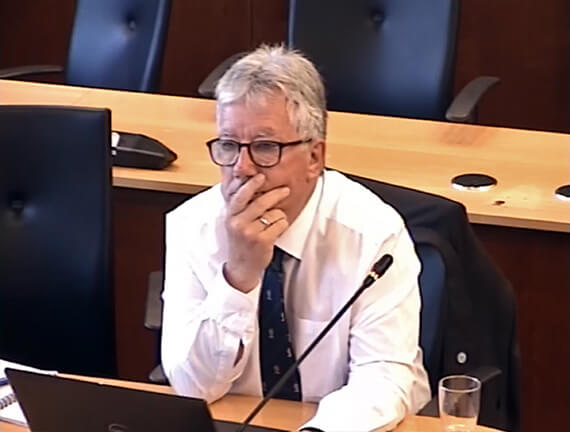 The committee then moved on to consider the four associated standards code breaches. Mr. Gardner didn’t take long. Before retiring to deliberate, committee chair Mr. Watt invited Cllr. Dennison to play his part.
A sullen Dennison, wearing his council-logoed tie for the occasion as if to convey authority, didn’t know what had hit him. You could almost hear the ‘interests’ ruling still echoing inside his head.
Chair: “Thank you, Mr. Gardner. Cllr. Dennison, you’re now invited to respond to the investigating officer’s representations and to make any representations you may wish to on whether or not you have failed to comply with the code.”
Dennison: “Uh, no comment to make on the investigation officer’s comments.”
Chair: “And just to be clear, do you wish to make any additional representations on whether or not you have failed to comply with the code?”
Dennison: “No additional representations.”
Chair: “Thank you. Are there any other points you wish to make before we consider whether or not we believe there has been a breach?”
Dennison: “No thank you, chair.”
The committee retired. Resumed. Guilty on all counts.
Now considering mitigation before sentencing, Dennison continued telling committee members why their prior findings were all wrong.
Meanwhile Huw was still trying to produce a winning argument from his limited repertoire, saying nothing that had any bearing on anything.
Stoic to the last, they were like the Titanic’s violinists. Struggling to stand upright against the list, yet still fiddling on deck even as the icy North Atlantic lapped at their ankles. You have to admire it, really.
The barrel had long been scraped through when Huw asked to chip in on Dennison’s reliability in attending meetings – he often “substitutes at short notice,” so as “to make sure democracy functions.”
I’ve seen more convincing hostage videos.
“None of us are perfect,” Huw pleaded – a self-proving statement for the linguists, the correct form of course being “none of us is perfect.”
In conclusion Huw included the immortal: “Best endeavours maybe sometimes go astray…”
Even at this late stage, you could sense the committee members willing Dennison to at least salvage something from this, the longest political car crash since the re-re-reappointment of Peter Mandelson to high office.
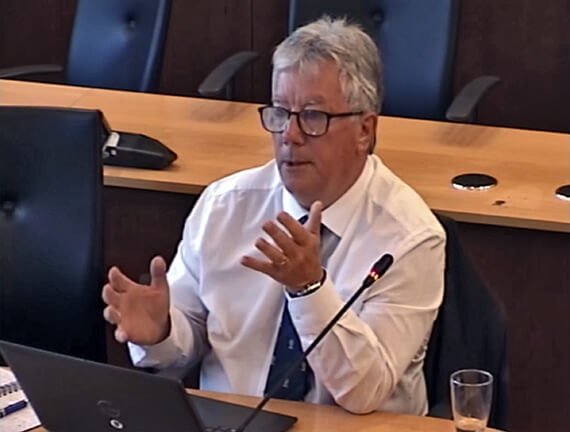 Contrition? Dennison was having none of it.
Forthrightness? Not here mate!
There was the continued obfuscation: “it was a grey area” and: “there’s a bit of ambiguity between what the monitoring officer’s advice is and what I consider, uh, her advice.”
The buck-passing: “it’s regrettable that the constitution didn’t cater for this,” and how: “they’ll have to change the constitution to get around this” plus “retraining for all involved parties.”
The Milford member was the victim. He felt very sorry for himself: “I’m slightly disappointed in this council,” with references to: “the bias I’ve experienced from the council” and “the vindictiveness from the two alleged claimants.”
Dennison had obviously chosen County Hall, over the Imperial Hall, as the venue for his pity party.
On being asked to consider whether his: “breach arose from an honestly held, albeit mistaken, view that the conduct involved did not constitute a failure to follow the Code, especially having taken appropriate advice,” Dennison claimed that this indeed applied to his situation.
But hold on.
“What about when you were told by the monitoring officer that you had a personal and prejudicial interest? Didn’t that ring some alarm bells?” he was asked by lay-member Ms. Maggie Hughes.
Course not! Yet another “grey area.”
On whether he had shown “recognition and regret as to the misconduct and any consequences,” he treated us to the total knee-slapper: “I certainly regret having to come here today.”
When invited to consider whether he had apologised, there was the non-apology: “An apology? I apologise if I did, uh, if I, if I’d wilfully violated any code or conduct, then I would apologise, certainly from a wilful perspective. It was a non-wilful breach, then apologies? Maybe a ‘lessons learned’ rather than apology.”
Another councillor has drawn up a list, which is doing the rounds, of where Dennison apportions blame for his misconduct.
It’s impressive not just by its length but its inclusion of both people and inanimate objects:
PCC’s monitoring officer
PCC’s constitution
PCC’s democratic services staff
The Public Services Ombudsman for Wales
Jacob Williams
The late Mike Stoddart
PCC’s assistant chief executive
The Conservatives
Unaffiliated councillors
Deputy council leader Paul Miller
His group colleague and fellow Milford councillor, Terry Davies
Dennison’s performance played a predictable part in his sanction, as delivered by the chair:
“The committee determines that the seriousness and consequences of the breach, particularly the blatant disregard of the specific authoritative advice of the monitoring officer and the potential reputational consequences for the council, that the breach is regarded as very serious.”
On considering how the standards regime’s sanctions are designed to “deter future misconduct, promote a culture of compliance, and foster public confidence in local democracy,” the chair continued, with my emphasis in bold:
“The committee determined that the options of no action and censure were not appropriate in this case.
We further determined that the basis for our consideration should be a mid-level of sanction or suspension. This put this as a start point of three-month suspension.
The committee then moved to consider mitigating and aggravating circumstances and determined that the mitigating circumstances were:
— A relatively short length of service as a councillor.
— A previous record of good service as a councillor.
— A preparedness to attend further training in code of conduct matters.
— And a commitment to seek further advice on the code in the future.The aggravating factors determined by the committee were:
— Seeking to unfairly blame others for your own actions.
— Deliberate conduct designed to achieve or result in personal benefit for another.
— Lack of understanding or acceptance of misconduct and any consequences of that misconduct.
— A refusal to accept the facts despite clear evidence to the contrary.
— And continuing to deny the facts despite evidence to the contrary.The overriding purpose of the sanctions regime is to uphold the standards of conduct in public life and to maintain confidence in local democracy. Accordingly, the committee has determined that a sanction of four-months’ suspension is appropriate in this case.
The committee’s decision and reasons will be confirmed in writing to the member, to the complainant, and to the ombudsman as soon as is reasonably practicable. Thank you. That concludes this meeting of the standards committee.”
They had started at 10am, it was now 4:40pm.
*Contrary to popular belief, a councillor’s misconduct suspension is unpaid. During proceedings Dennison claimed: “in effect, I give all my salary to charity.”
The meaning of the words “in effect” went unprobed.
He went on: “it goes to a dogs’ hospital in Sri Lanka, and it goes to people who’ve helped street dogs in Sri Lanka. Very close to my heart.”
If Alan returns from his enforced absence with a bronzy glow, no prizes for guessing where he earnt his ban-tan.
 Poetry from Bridges, waxing lyrical on Alan’s ethical compass: “I can say with absolute certainty that Cllr. Dennison, uh, for all of his, um, um, uh…”
Realisation dawned – he’d driven into a cul-de-sac – the next word of this cliché was obviously “F A U L T S.”
He completed the non-sequitur: “…all of his, um, talents, he’s a very professional individual, and he has not at any time, in my opinion, crossed the line by sharing information with myself or giving me guidance on this matter.”
Nobody had claimed he had.

You could be the first to comment.