

Sunday, 3rd March, 2013
Black Thursday
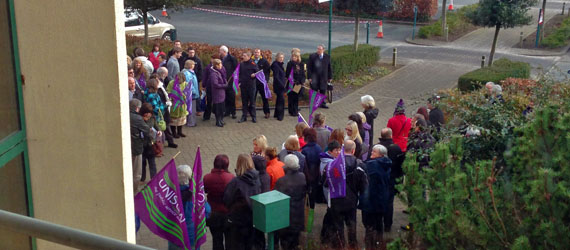
With protesters at the door of County Hall on the way in, and a packed public gallery eager to witness debate on the council’s controversial pay and grading review; Thursday morning’s meeting had the recipe to be an interesting affair.
And so it turned out to be. With 99 items on the agenda, the council’s first meeting of 2013 didn’t finish until nearly 8pm.
Readers will remember that before the meeting, Labour leader Cllr. Paul Miller had come up with a neat way of preventing the votes relating to the pay and grading review from being referred to a future meeting of council, which is the norm for new proposals. But there was a fly in the ointment, and it gave ‘those upstairs’ a chance to threaten to adjourn the meeting and reconvene at a future date, rendering the time-sensitive pay and grading motions almost useless.
It was an afternoon function at Cawdor Barracks. With the pay and grading review motions right at the foot of the bill, the meeting could never have been finished in time for partaking councillors to be in Brawdy by 2.30pm. A number of us, myself included, had pointed out the potential for a clash as soon as the agenda was published, but I have strong reasons to suspect Brawdy was used as a pawn.
The original motions on this topic were set out in the following terms:
Cllr. Paul Miller
“That this council resolve that the chairs of all appeals committees convened in relation to the pay and grading review be truly independent.
As such this council directs that an individual may only be selected to chair such a committee where his/her independence has been agreed by the Head of Human Resources at Pembrokeshire County Council and all recognised trade unions. “
Cllr. Paul Miller
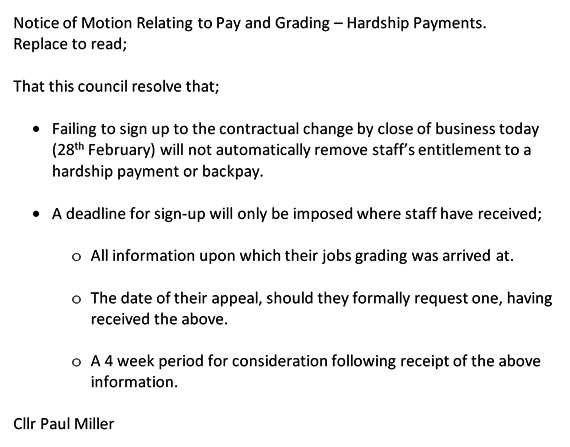
“That this council resolve that no member of staff, who does not sign up to the contractual change by close of business today (28 February 2013), will be denied a hardship payment where an agreement is subsequently reached. ”
Cllr. Gwilym Price
“That this council requires a review be undertaken of all Job Descriptions and Departmental Operational Procedures, reporting to the Corporate Governance Committee before the end of May 2013. This review shall look specifically at:
1) When the job description for each council post was last reviewed in conjunction with the member of staff in the post to which it relates.
2) The robustness of procedures to ensure an annual review of that job description with the post holder.
3) The current levels of compliance with those procedures, by directorate.
The report shall consider the position as on 28 February 2013.
Subject to its findings this review shall make recommendations for the strengthening of existing operating procedures and better ensuring compliance.
Suggested outcome: Better accountability and transparency between staff and management through a robust quality system. “
Cllr. Reg Owens
“As a result of recent job evaluation findings a large number of staff, many of whom are already on low grades have had these reduced, this will result in tremendous distress and hardship to those affected.
To assist in alleviating this hardship to many key workers I propose that these staff have their current pay and conditions frozen for a period of three years thus giving them time to make the necessary adjustments to their family financial commitments and confirming our position as a fair and compassionate employer.”
As councillors turned up to the meeting, they were greeted with a sheet of paper in front of them from Cllr. Miller, with an amended version of the second motion listed above:
One of the suggestions rumoured before the meeting was that the leader and chairman had planned to end the meeting at 1.15pm to go to Brawdy. When I asked him at the start of the meeting whether this rumour was true, the chairman confirmed it had been considered, but didn’t rule it in or out. Another rumour doing the rounds was that, had councillors successfully pushed for all of the pay and grading related items of business to be voted on – and there’s every reason to believe there was the support in the chamber for this to be a reality, then the chairman would have adjourned the meeting to go to Brawdy, and reconvened another day. This would obviously not do, because for the February 28th blackmail deadline to be acted upon, it was imperative for action to be taken on Black Thursday.
With the chairman’s limo revving outside County Hall and the 2.30pm jolly at Brawdy fast-approaching, Cllr. Miller’s amendment was brought forward on the agenda, and the time it went to the vote can’t have left much opportunity for small talk upon arrival at the barracks.
After a reasonable debate against the clock, the council unanimously voted to pass the amended motion, after which the chairman announced the meeting would be adjourned, and would reconvene after the Brawdy trip at 4pm. During the two-hour interval, the Western Telegraph reported the meeting’s progress online. I’m somewhat glad to see that the report of it mentions “What is not yet clear is whether staff who have already signed can withdraw their letter and reconsider with the full information available.”
It is not yet clear to me, either. Though I’m led to believe this motion will not have any impact on the 95% of staff who had already signed up to their new contracts. I’m of the firm belief that, out of fairness, every single member of staff should be able to reconsider in light of council’s ‘Black Thursday’ resolution. It’s immaterial whether 10, 100, or even every single one of those staff members indicated that they had signed up ‘under duress.’ The terms of this resolution should be afforded to all.
Had Cllr. Miller gone all the way with all of the motions on this topic and called for his motion relating to the independence of the appeals panel chair, or Cllr. Gwilym Price’s proposition over job evaluations to have been debated, then I don’t think it would have been an easy decision for the chairman to have adjourned the meeting to another day. The leader hasn’t come up smelling of roses as it is, so would the risk have been taken to deny councillors their say? I’m not convinced even Cllr. Adams would be so bold. There would surely have been an unholy onslaught from the public gallery, the press, and not to mention councillors. As it is, all councillors, following Cllr. Miller’s lead, have supported something which, under closer scrutiny, offers absolutely nothing at all to the 95% who had already signed up before the meeting.
Barring legal channels, the only way members of staff who regret signing up can benefit from it, is through further co-operation and negotiation between the council and the unions, who, I understand, are now keener than ever to get back around the table.
The ’employers’ – councillors – made their position as clear as they possibly could under the limited scope given to them at Thursday’s meeting, many of us disassociating ourselves from the council’s implementation of the pay and grading review by declaring “not in my name.” Whether or not officers and the unions can make any real difference to those who signed up under duress, remains to be seen. I think a big opportunity was wasted. Apart from the motion voted on, all of the others listed above, have been kicked into the long grass. They may come back to the May meeting of council, by which time the appeals process will probably be well underway, if not completed. A very limited compromise may have been reached under the veiled threat of the meeting’s adjournment to another day. Given that only 5% of staff had not signed up by the start of the meeting, was it really worth the compromise to pass this motion which gives no benefit to those who had signed up under duress? It’s utter barracks.
In the negative
The results of a survey of members to ascertain their views on the current frequency of council meetings was reported back to council at Thursday’s meeting. It arose out of a Notice of Motion I submitted last summer. At the time I proposed that the number of meetings held per year should be looked into, with a view to increasing them to allow business to be conducted more often. At October’s meeting, with my support, council resolved that a survey be conducted of members to ascertain their views, the results of which were included in the thick agenda.
I said there was no better example than this meeting, of the accumulation of items cropping up at meetings of council. In my view, this is largely down to the fact that the council only meets five times per year. The Brawdy balls-up was still up in the air at this point, and nobody quite knew what would happen at 1.15pm which, as the chairman had earlier confirmed in answer to a query of mine, had been suggested as an opportunity for cutting the meeting short, and if it was cut short, whether it would reconvene on another day, or later in the afternoon.
Debate was quite fruitful, and when the leader chipped in, he suggested that the number of questions and items on the meeting’s thick agenda might be part of an opposition campaign to give credit to a proposal for more council meetings per year. This outlandish theory would have been best left inside the closed doors of the IPG’s secret meetings. Two of these shady gatherings were held last week in preparation for ‘Black Thursday,’ and an IPG mole tells me a similar yarn over a possible link between the lengthy agenda and my move for additional meetings was spun to the IPG party members present.
As Cllr. Adams feels it won’t harm his credit to be seen putting crackpot theories out into the public domain, then I don’t see why I should be concerned either. How about the possibility that IPG party members were whipped into responding to their surveys indicating no preference for change? Fifty of the county’s sixty councillors completed their postal survey, which is a vast improvement on previous occasions where councillors have been voluntarily asked to complete and return paperwork.
The tone of debate came down to whether or not current meetings were effective and able to cope with the issues and matters cropping up within them. Arguments were put forward that the current situation was not effective and that something needed to change, many of which didn’t support my proposal to increase the number of meetings per year by three.
Cllr. Adams disagreed entirely, and put forward an oral amendment to my motion that the status quo should remain, and that there should be no change to the current frequency of meetings. The chairman was advised to take it to the vote, at which point I raised a point of order. The constitution prevents an amendment to a motion which negates the motion. The relevant part is copied below:
Amendments to motions
(a) An amendment to a motion must be relevant to the motion and will either be:
(i) to refer the matter to an appropriate body, Committee or individual for consideration or reconsideration;
(ii) to leave out words;
(iii) to leave out words and insert or add others; or
(iv) to insert or add wordsas long as the effect of (ii) to (iv) is not to negate the motion.
Unable to prove that I was wrong, and unwilling to accept that I was right, the highly-paid Oxford-educated Chief Executive ruled (through the chairman) that the amendment was valid and should be taken immediately.
There is, in my view, quite a simple way of confirming that Cllr. Adams’ amendment unconstitutionally negated my motion, though I’ll draw short of calling it fool-proof. And that is: had my motion instead been taken and voted down, the status quo (which was proposed in Cllr. Adams’ amendment) would have remained, unless a further, legitimate amendment was moved and voted upon successfully.
Regardless of the advice upon which it was based, the chair’s ruling that the amendment be taken gave rise to a subtle distinction. It gave members who didn’t necessarily support my proposal, but who also disagreed with the leader’s preferred option of retaining the status quo, the chance to register their feelings. I called for a recorded vote, the results of which appear below:
IPG
Jamie Adams
John Allen-Mirehouse
Daphne Bush
John Davies
Mark Edwards
Lyndon Frayling
Huw George
Brian Hall
Simon Hancock
Paul Harries
Umelda Havard
Mike James
Lyn Jenkins
Michael John
Keith Lewis
Rob Lewis
Pearl Llewellyn
Peter Morgan
Elwyn Morse
David Neale
Reg Owens
Myles Pepper
David Pugh
David Rees
Tom Richards
Ken Rowlands
David Simpson
David Wildman
Arwyn Williams
Steve Yelland
Plaid Cymru
Rod Bowen
Stephen Joseph
Jonathan Preston
Rhys Sinnett
Michael Williams
Labour
Pat Davies
Alison Lee
Paul Miller
Sue Perkins
Gwilym Price
Tom Tudor
Guy Woodham
Unaffiliated
Phil Kidney
David Lloyd
44
Unaffiliated
Phil Baker
Tony Brinsden
David Bryan
Mike Evans
Tessa Hodgson
Owen James
Bob Kilmister
Jonathan Nutting
Peter Stock
Mike Stoddart
Vivien Stoddart
Jacob Williams
Phil Baker
Tony Brinsden
David Bryan
Mike Evans
Tessa Hodgson
Owen James
Bob Kilmister
Jonathan Nutting
Peter Stock
Mike Stoddart
Vivien Stoddart
Jacob Williams
IPG
Wynne Evans
Conservative
David Howlett
Stan Hudson
15
Labour
Tony Wilcox
Tony Wilcox
1
The fruits of his Labour
Perhaps the biggest howler of the meeting came during the vote over the adoption of new terms of reference of the council’s Corporate Governance Committee, where Cllr. Paul Miller failed to get all of his party members to vote the party line, putting him into a position he wanted to avoid.
Seats on Corporate Governance are allocated to councillors upon the political balance rules – to reflect the composition of the council’s membership. The debate on whether or not to approve the terms of reference centred on just one issue: as proposed, they required party leaders to appoint their scrutiny committee chairs to sit on the Corporate Governance committee.
The effect of this on Labour, which has two seats on Corporate Governance, would mean that party leader Cllr. Paul Miller could retain his seat, but would be bound to appoint Cllr. Tom Tudor, who holds the party’s Overview and Scrutiny Committee chairmanship, rather than being able to exercise his own control over who he can appoint from among his members.
Cllr. Michael Williams, the leader of Plaid Cymru, went into the meeting holding the party’s one seat on Corporate Governance, but, if the terms of reference were approved as recommended, he would have to involuntarily relinquish his seat and appoint Cllr. Rhys Sinnett, who serves as the party’s chairman on the Safeguarding Overview and Scrutiny committee.
Votes for and against were tied, 27-27. The chairman used his casting vote to support the recommendation for adoption, after which Cllr. Sue Perkins of Labour, wished for it to be recorded in the minutes that she abstained. As a result, Cllr. Michael Williams will now have to come off Corporate Governance, and, as far as her own party is concerned, Cllr. Perkins’ leader has had his discretion unceremoniously and, albeit totally avoidably, removed.
Whether Cllr. Perkins knew of the consequences of her decision before it came to the vote, we may never know. She’ll have a hard job explaining why she voted against the Labour party’s line to effectively support the IPG’s. One thing, though, is for sure: her awareness of the consequences post-vote. What I have failed to mention up until this point is that Cllr. Perkins sat alongside her party’s leader as Labour’s second member of the Corporate Governance Committee, and will, as a result of abstaining, have to give up her seat in favour of the party’s Chairman of the Children & Families Overview and Scrutiny committee.
But the story doesn’t end there. Following Thursday’s meeting, Cllr. Miller appointed himself to replace Cllr. Tudor as chairman, and, presumably, will also take over the SRA that comes with it.
To have taken this step, Cllr. Miller must place great value on his ability as the party leader to appoint whoever he chooses to sit alongside him on Corporate Governance, because his own seat on it was not in any jeopardy. Removing Cllr. Tudor’s chairmanship might allow Cllr. Miller to remain in the position to appoint whoever he wants to Labour’s other seat, but to the casual observer it does seem rather a big move. Labour members in any form of sedentary position – either on a seat or in a chair – would be well advised not to get too comfy in future, and to take nothing for granted.
4 Comments...





Recent posts…


What a tangled web of bureaucracy. No wonder this Council is in such an absolute mess.
Many thanks Jacob for the update on the Pay and Grading motions, not having the luxury of the opportunity to attend it’s been difficult to find out exactly what happened. I did learn that before the Brawdygate break, the amended motion agenda item number 91 had been agreed unanimously which was certainly one in the eye for the CEO in particular and PCC senior management team in general, but have struggled to hear about the other NOMs, and it will no doubt by weeks before the minutes get published.
Are you able to shed any more light on where they were referred to, or are they simply postponed until next Council?
Hi Weasel, they were all sent off to the cabinet.
That worthwhile forum for debate renowned for its make-up of dissidents and its politically-balanced deliberations!
Many thanks for a clear explanation of exactly what went on at the meeting on 28 February. The report in the press made it seem as though things were possibly better than they actually are for those of us who have lost out in the pay and grading review. We cannot understand why our extremely highly paid senior council officer ‘colleagues’ want to deny us a living wage. Can’t wait till they award themselves another pay rise as a reward for all their hard work in forcing this review on us lesser mortals.