

Wednesday, 27th June, 2012
Extraordinary meeting – police desk closures
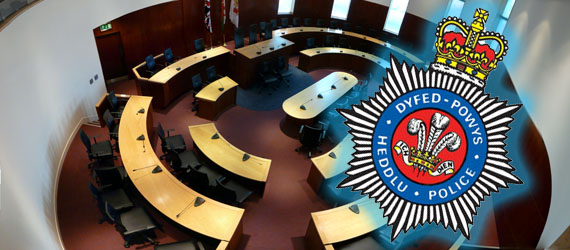
The extraordinary council meeting was held today, following a requisition submitted by Councillors Mike Evans, Rhys Sinnett, Stan Hudson, Pat Davies and Vivien Stoddart.
The item of business they brought to the table is as follows:
Given that Dyfed Powys Police force has announced plans to close public desk facilities at each of our largest town Milford Haven, the strategically important ferry port of Fishguard and the town of Tenby, and given the need to respond urgently to these proposals with their social implications, this Council should discuss and thereafter oppose these closures and should call upon the Chief Constable and Police Authority to reverse these cuts to the police service presently afforded to the people of Pembrokeshire.
The extraordinary meeting was called in response to the announcement by Dyfed-Powys Powys Police of a 90-day consultation.
The meeting lasted over three hours and was also attended by the deputy chief constable of Nick Ingram representing the newly-appointed chief constable Jackie Roberts.
He gave a background presentation relating to the financial constraints both locally and nationally, as a consequence of which the police authority has committed to achieve savings of £13.1m by 2015/16.
We were told that footfall figures were obtained for the three police stations in question, which had such low numbers using their front desk facilities as to warrant their closure.
This “changing behaviour” can be attributed, partly, to the different ways in which the public now communicates with the police. The stations earmarked for front desk closures will have an external intercom unit through which complaints and queries can be relayed to an operator at a central unit.
One councillor likened the system to a McDonalds drive-thru order, though instead of “do you want fries with that?” we can expect to hear a rendition of Mozart before an endless list of options is relayed bilingually.
The meeting heard that another way to overcome the effects of the closures is to increase visible policing, to engage with the community more, and for officers to come to those concerned rather than the other way around.
After DCC Ingram’s presentation the council’s chairman opened the floor for members to put forward comments and questions.
Two councillors raised concern that, whilst the premises occupied by Fishguard police station was suitable many years ago for the town’s policing needs, it was now far larger than necessary.
They said the property was also considered to be particularly valuable real estate and could fetch a large sum if sold. As it was one of the towns at risk of losing front desk services in a bid to free up cash, consideration could be given to relocating to a smaller, less valuable property.
Tenby station’s footfall figures demonstrated two enquiries per hour were directed to the front desk. In answer to a question from the town’s Cllr. Mike Evans, it was confirmed by Mr. Ingram that this ‘footfall survey’ was conducted at the beginning of October three years ago.
As Tenby is so heavily tourist-reliant, its population and that of the surrounding area fluctuated largely – chiefly during summer, but also at numerous times of the season – so the figures aren’t a true reflection, Cllr. Evans said.
Cllr. Keith Lewis also raised concern over the sort of people likely to be affected by the proposals, those less amenable to the alternative arrangements for accessing policing services and reporting crime.
A similar point made by Cllr. Jonathan Nutting was that in some instances people would be far less comfortable speaking to an intercom out on the street or typing an email, than talking face-to-face with a station officer, and that a follow-up appointment with an officer was not always going to be appropriate, possibly wasting further resources than necessary.
Cllr. Peter Stock questioned whether these proposed cuts are part of a centralisation of all policing matters within Dyfed-Powys to Carmarthen alone, an observation noted by a number of other councillors.
I asked how could an honest member of the public who found a purse or handbag on the street, hand it in to the police over the internet or down a telephone line?
Mr. Ingram said alternatives would be put in place so that officers would be more visible and active in their community, and follow-up appointments or call-outs could be arranged for anybody visiting the stations who spoke to the intercom.
In addition, Mr. Ingram pondered whether the reason these police stations had such low footfall was because their locations were unknown, or inaccessible.
I responded by stating that if anybody in the chamber went to Tenby and asked a random passer-by in the street where Tenby police station was located, they would be directed exactly to the spot; and that if, instead, they had asked that passer-by where the local PC or PCSO was at that moment in time, no such answer could be provided.
As soon as Cllr. Mike Evans proposed his motion, seconded by Cllr. Viv Stoddart, the leader, Cllr. Jamie Adams, proposed a completely reworded amendment, calling for the expression of ‘concern,’ over the police’s proposals, rather than to to ‘oppose’ them.
His alternative also called for the police to consider working with the council to provide similar services to those that would be lost if these proposals were carried out.
The amendment was worded as follows:
That the Council expresses concern to the Chief Constable about the effects on citizens of the proposed closure of public enquiry offices at three locations in Pembrokeshire; however, in the event of the Chief Constable deciding to proceed, the Council calls upon the Chief Constable to provide similar facilities through partnership arrangements with the Council (subject to cost reimbursement), or with any other organisation.
Proposed by Cllr. Jamie Adams, seconded by Cllr. Ken Rowlands.
Cllr. Pat Davies stated her concern that the council was not a consultee in the 90-day consultation for this proposal, and that had it not been requisitioned, this item of discussion would not have come to county councillors for their say, and the meeting wouldn’t have taken place.
Though the leader proposed the amendment, Cllr. John Davies was given right of reply to almost all of the contributions made by all members in the chamber.
He is our representative on the police authority, after all, and was at pains to point out that this decision was not within the remit of the police authority on which he still serves as one of the council’s appointees, and that it was entirely in the hands of the chief constable.
There was much amusement when one of the leader’s cabinet appointees mistakenly referred to Cllr. Adams as the “deputy” leader.
Cllr. Mike Stoddart requested confirmation from the chair and/or the chief executive that there were no legal implications to the proposal for council employees to conduct functions of the police. He referred to an earlier statement by DCC Ingram in which he expressed concern over duty and custom.
The police and its officers swear allegiance to the crown, whilst duties related to local politics are very much aligned to the state. The chief executive could confirm neither way over any legal implications, only that these would have to be looked into should the council decide to vote in favour of the amendment.
As proposer of the original motion, Cllr. Mike Evans was allowed the final say before the vote. In it, he reminded members of the not dissimilar situation fewer than eighteen months earlier, in which the coastguard stations faced closure, a proposal that was also not within the remit of the council or any body to which the council makes an appointment.
As for the argument put forward by Cllr. John Davies – that it is not appropriate for the council to ‘oppose’ the front desk closures proposal, Cllr. Evans reminded members again, that, in 2011 the council opposed the coastguard closures, with not a single member voting against – and that eventually the stations were saved, public opinion having been listened to.
Alluding to a series of other money-saving police service cuts suffered in Pembrokeshire as a ‘drip’ effect, he expressed real concern that unless strong opposition to these proposals was registered, policing in Pembrokeshire would eventually ‘run dry.’
A recorded vote was called for, and the votes were cast as follows:
IPG
Jamie Adams
John Allen-Mirehouse
Daphne Bush
John Davies
Mark Edwards
Lyndon Frayling
Brian Hall
Simon Hancock
Paul Harries
Umelda Havard
Mike James
Owen James
Lyn Jenkins
Michael John
Keith Lewis
Rob Lewis
Peter Morgan
David Neale
Myles Pepper
David Pugh
Ken Rowlands
David Simpson
Peter Stock
Arwyn Williams
Steve Yelland
Unaffiliated
David Bryan
Conservative
David Howlett
27
Labour
Pat Davies
Tom Tudor
Guy Woodham
Sue Perkins
Pat Davies
Tom Tudor
Guy Woodham
Sue Perkins
Unaffiliated
Mike Evans
Tessa Hodgson
Phil Kidney
Bob Kilmister
Jonathan Nutting
Mike Stoddart
Vivien Stoddart
Jacob Williams
Plaid Cymru
Stephen Joseph
Rhys Sinnett
IPG
Pearl Llewellyn
Reg Owens
16
IPG
David Rees
David Rees
1
Televisioff
When I came into the chamber just before 10am a cameraman was positioned in the walkway right alongside my seat.
In conversation he told me he was from BBC Wales and was recording for the afternoon news. When the meeting got underway he disappeared, to make his way up the M4 to submit his footage in time for the 1.30pm bulletin, or so I thought.
At around 12.50pm my attention was drawn to a clearly restless character leaning over the rail of the public gallery, huffing and sighing. This was the aforementioned BBC cameraman who I can only assume had anticipated this being a short meeting, and had hung around hoping to conduct a short interview or two afterwards.
It was a given that his earlier footage could not now make the afternoon bulletin, but I tuned in this evening where there wasn’t even a mention of the story.
This isn’t the first time democracy in Pembrokeshire has been spurned by the BBC, whilst also wasting resources.
At the election count on May 4th a tripod-mounted camera was manned by another BBC operator in the corner of the sports hall.
None of the footage made it to the airwaves. The editorial control of the BBC is not on my list of priorities, but in this current financial climate, the time, effort and man-hours wasted on both occasions – not to mention the other costs involved – should surely be questioned.
 Check out and 'like' my Facebook page ↴
Recent posts…


You could be the first to comment.