
Wednesday, 10th June, 2015
PCC’s latest letter from WAO
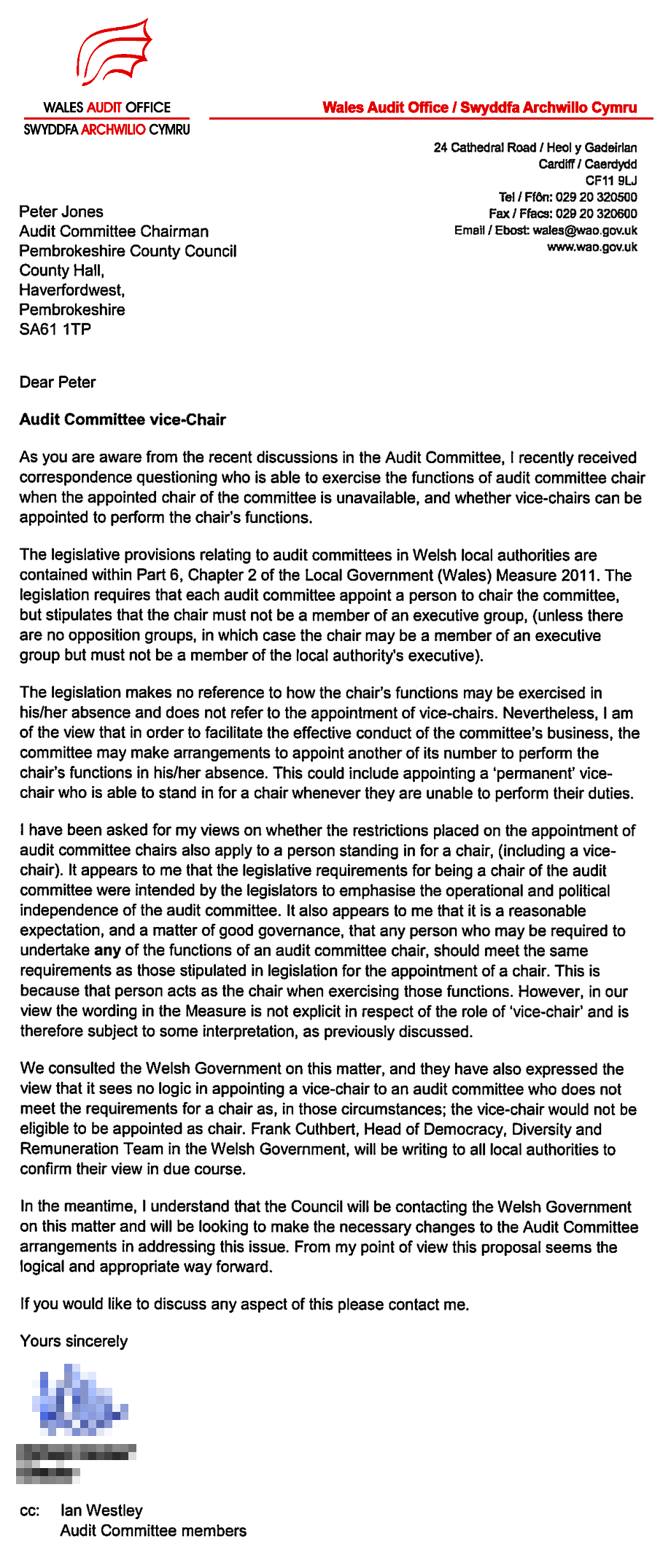
As a member of Pembrokeshire County Council’s audit committee I was recently sent a nice letter by the Wales Audit Office. It provides the last word on the council saga harking back to December in which little old me made a stand against the authority’s legal might.
I’ve reproduced the letter in full at the bottom of this post.
It all started with the absence from the December meeting of the audit committee’s appointed chair, its non-councillor lay-member, Peter Jones.
Mr. Jones is a lawyer who has former ties to PCC and other local bodies in the county, but hails from Swansea where he is a big noise in the city’s university. He became the audit committee’s sole co-opted member in some interesting circumstances last year following a bizarre ‘recruitment’ exercise used by the council to fill the vacancy following the former incumbent’s high profile resignation.
It was deemed – by whom, it remains unclear – that not enough quality candidates had applied for the role by the official deadline. Subsequently council officers took it upon themselves to extend the application window, during which time only one further application was submitted – that of Mr. Jones.
Not only did he end up landing the gig but Mr. Jones also found himself on the receiving end of an immediate promotion to the committee’s chairmanship at his very first meeting on 22nd September.
The December 2014 audit committee meeting would have been Mr. Jones’ second jaunt down the M4 for his co-opted role had he not tendered his apologies. In his absence, the committee’s vice-chair Cllr. Mike James – a member of the council’s ruling party the IPPG – assumed the chair to open the meeting.
At this early stage I pointed to a rule passed by the Welsh Assembly in creating audit committees which seemed clear to me that it forbade any executive group member – as Cllr. James was – from chairing unless there was no alternative member who could act in the role, of which there were two, me (unaffiliated ‘proper’ independent) and Cllr. Guy Woodham (Labour.)
But none of the rest of the IPPG-dominated committee were having any of it. A legal officer was called down from upstairs, who, after a quick consultation of the 2011 Wales Local Government Measure, advised that the rule I referred to only applied to the appointed chair. And, as Cllr. James was only chairing in the absence of the appointed chair, everything was hunky-dory.
So despite my protest Cllr. James carried on and chaired the meeting to its conclusion.
I pursued this matter afterwards as it seemed clear to me that Cllr. James should not have chaired the committee in the circumstances as the rule I cited applied to “the person who is to chair the committee,” which even the legal officer didn’t dispute Cllr. James amounted to for that meeting.
The story I was given subsequently by the outgoing monitoring officer, Laurence Harding, was slightly inconsistent with the story given to the meeting on the day, but it had a common theme: an unwillingness to concede any error had been made, and that I was wrong.
It came to my attention that in one internal email to his colleagues that wasn’t intended for my consumption, Mr. Harding made reference to my lack of legal qualifications and my unwillingness to accept his advice (see below.)
He suggested an external opinion on the matter may be one way of, to put it frankly, shutting me up – or “silence” me as the Pembrokeshire Herald reported at the time.
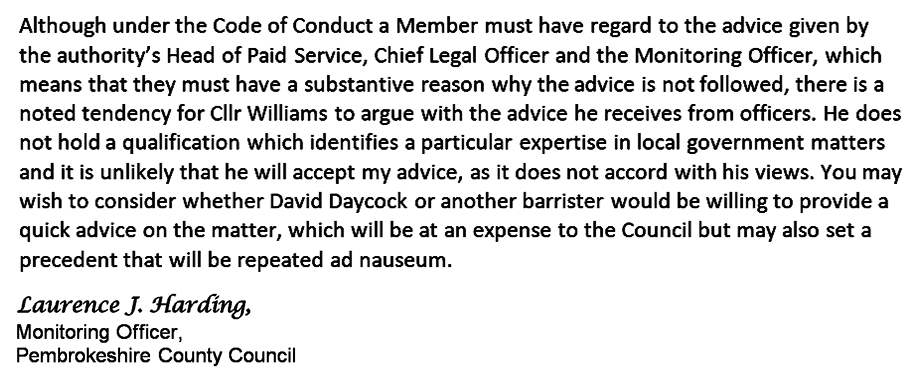
Mr. Harding’s idea of engaging an external brain was pursued and a full effort was mounted to overcome the young upstart who was maintaining there was a clear requirement that the audit committee must not be (and should not have been) chaired by a member of the ruling group.
The rule is in place for good reasons – as its remit involves scrutinising matters under the charge of the executive, the committee should be chaired by a member who is operationally independent of the executive group/s. Common sense, you may say.
The external lawyer they roped in to get them out of the mud was a council regular, Simon Morgan from St. John’s chambers, Bristol.
As I published on this blog earlier this year Mr. Morgan’s instructions weren’t what you might expect. They can be summed up thus: “Hi, Si! We’re in a pickle, can you help?”
Attached to the informal email in which Si was instructed was a copy of the monitoring officer’s lengthy email which referenced my repeated refusal to accept his advice – a trait which has served me quite well on the council as readers will recall I’ve variously recounted Mr. Harding’s errors on this blog over the years.
Mr. Morgan must be used to reading between the lines because despite the lack of clarity in his instructions he seemed to be in no doubt over the desired result.
And in arriving there, Mr. Morgan got clever. And by clever, I mean resourceful. And when I say resourceful, he thought so far outside the box he was unable to find his way back in.
He suggests that PCC’s audit committee went by the book and did nothing wrong in December because the rule I referred to only applies to the person who chairs “the committee” – whereas Cllr. James didn’t chair “the committee” he just chaired “a meeting” of “the committee” in the absence of the chair.
This distinction, he maintained, reveals two entirely different concepts which gets PCC off the hook.
Codswallop!
I’ve since learned that our man from Avon – Bristol’s best back-scratcher – hails from Pembrokeshire. It’s a small world!
And you, dear readers, paid for the privilege of obtaining his handiwork. As a demonstration of loyalty to an instructing client, it’s a model case study. But as an independent source of legal opinion, it would be difficult to argue.
This convoluted work of fantasy didn’t convince me or others at the time and, unfortunately for rent-a-brief, the recent letter I received from the Wales Audit Office – which shreds his effort to pieces in the diplomatic fashion only public bodies have the restraint to show – reveals I’m not alone.
As well as agreeing with what most of us have been saying all along – that the rule Cllr. James breached when he chaired December’s meeting was intended by the lawmakers “to emphasise the operational and political independence of the audit committee,” our saviour at the WAO makes another clear pronouncement:
“It also appears to me that it is a reasonable expectation, and a matter of good governance, that any person who may be required to undertake any of the functions of an audit committee chair, should meet the same requirements as those stipulated in the legislation for the appointment of a chair.” [Original emphasis included.]
As regular readers of this blog will know, “reasonable expectations” don’t tend to happen at the Kremlin, where, in the days and weeks following December’s audit committee meeting, the council’s legal officers were busy cementing their case that the rules weren’t designed the way I interpreted them and Cllr. James was perfectly able to chair the committee like he had done.
But the best part of it all – and which shows the thorough job of the WAO’s officers – is their letter leaves Simon Morgan and the council no wriggle room. The very next line explains exactly why Si’s smart aleck distinction was hopelessly flawed:
“This is because that person acts as the chair when exercising those functions.”
So, Cllr. James chaired the meeting and the committee – between which the WAO accepts no distinction – which was a situation the rules intended to prevent.
Even though the legislation didn’t expressly cater for the eventuality of an appointed chair’s absence, it should have been common sense or a “reasonable expectation” and a matter of “good governance” in the WAO’s words, for whoever chaired the meeting in his or her absence to comply with the legislative requirements.
But what is clear is the inability – or unwillingness – to admit any error and such determination to save face that they threw the kitchen sink at the problem, including spending an undisclosed sum on our external legal chum.
The WAO’s letter is addressed to Mr. Jones and copied to audit committee members plus the acting head of paid service.
I find this interesting because Simon Morgan’s ‘advice’ was reported to a subsequent audit committee meeting where I explained how poor it was. During the course of events our learned chairman, Mr. Jones – who happens to be a solicitor of forty-four years’ repute – followed an uncannily similar tack to the authority’s monitoring officer. He asked me if I held any legal qualifications to know what I was talking about.
Mr. Jones’ questioning of my credentials was reported by the Pembrokeshire Herald, whose article I reproduced in full on this website in February.
It all goes to show that a good grasp of the English language and a reasonable interpretation of the rules can be enough to overcome a hostile attitude of absolute denial, backed up with unlimited corporate resources including external and internal lawyers and a supposedly impartial monitoring officer who appears more keen to question an elected member’s motives than to fully get his head around the issue before him.
The temptation to use the old adage “I told you so” is, like all clichés, one I shall resist.
At the end of the day, all I can say is there isn’t any egg on this layman’s face.
And, when all is said and done, I’m not the one eating humble pie.
But, as I said, I’m not one for clichés.

We may be a nation governed by law, the problem arises when lawyers become involved. The level of integrity matches bankers in the currency markets.
Man with no legal qualifications 1, those with legal qualifications 0.
Well done Sir!
Are we to assume that the decisions made at the December 2014 meeting will be declared null and void?
Will PCC Legal services be pursuing Morgan for damages relating to his duff advice, tearing up his contract and looking to engage a more competent lawyer?
Will Jones be asked to stand aside as Chairman to be replaced by someone who knows what they are doing?
Will Harding have his pension arrangements reviewed to reflect the true quality of service delivered to PCC over the years?
Will PCC Head of Legal Services be called before Council to formally explain why they made such a dog’s breakfast of interpreting rules that would be clear to any thinking layman?
Will Westley make bold moves to ensure the systemic problems apparent don’t resurface?
Will you Jacob, be publishing on this website a copy of the letter of apology that Harding must be penning right now?
Can’t wait!
Well done Jacob, you have shown up the Council’s legal section for what they are.
One phrase in the WAOs letter referred to GOOD GOVERNANCE but of course that is precisely what is lacking in Pembrokeshire.
I trust that at the next meeting the officers involved will have the good grace to stand up, admit their errors and apologise to you.
“Science is the belief in the ignorance of experts.”
― Richard P. Feynman, Nobel Prize winning physicist.
Abusing public funds springs to mind. The solicitor providing the legal advice should be investigated for providing opinions that it seems had nothing to do with the facts.
When is someone going to call a no confidence motion on Jamie Adams?
It’s not about having a relevant qualification in law… it’s how the law is interpreted and understood. Well done Jacob!
I wonder which part of “must not be a member of an executive group” they didn’t understand.
Clearly, Jacob, you were not in agreement with the outcome sought by officers and the IPPG leadership who bent or interpreted the law to suit their requirements, and worse, sought legal advice, at our expense, to support their opinions and advice.
Did this incident take place after the new ethos of the Council was heralded?
Perhaps a close inspection of the chairman’s appointment process is in order.
No wonder the WAO is to look closely at “contentious” legal issues in its PCC 2015/16 Audit Plan.
What confidence can councillors, and we, have in “unbiased” advice given by the Council’s professional officers and external sources? These people are masterminding the new Constitution and will be advising councillors on the detailed provisions and interpretation.
Reflecting. Enough is enough. It’s time for change. It’s time to review the competency and motives of officers at all levels who believe they are above challenge.
It’s time to eliminate the elected sheep. It’s time to confront the leader who has nurtured this self serving culture. It’s time to publicly voice a lack of confidence in those who support such obvious hegemony.
When did the people of Pembrokeshire give a mandate to those officers and elected representatives to whom we pay such generous salaries to deliberately attempt to stifle common sense and demean the efforts of the honest few who struggle to maintain accountability whilst working on behalf of the electorate?
I have been attempting to compile a list of contentious decisions or issues, perhaps others can help. So far I have got:-
1. The CEO pension, as approved by Senior Staff Committee, fell over due to a failure in proper decision making procedures. This was followed by the advice about predisposition and/or predetermination by councillors and disqualification to take part in a vote.
2. The Disciplinary Committee found that the CEO did have a case to answer, but the “proper procedure” was halted when 29 councillors voted to approve a negotiated termination agreement without being in possession of all relevant considerations to the extent that an unlawful sum was included in the settlement.
3. Councillors were advised that they could take part in debate about schools reorganisation, but not vote. Such was the county-wide scope of these proposals I find it difficult to imagine that a reasonable person would consider that any councillor could be influenced by personal and prejudicial interest to the extent that it would affect their voting. However the Standards Committee did reach this conclusion and as a consequence, some constituents were denied representation. (Perhaps they know our councillors).
4. There is the grant scheme, rumbling along in the background, where internal audit gave a clean bill of health, and meeting minutes were altered retrospectively.
5. The former Audit Committee chairman’s resignation and the appointment procedure for the replacement and the subsequent legal advice.
6. I have my doubts about the way in which the significant, successful 21st Century Schools bid was bounced on councillors with a £12m reallocation of reserves. (There was no debate about the effect on the services that lost their allocated reserves.) We seem to be in the position of fulfilling the bid obligation come what may. There has been no review of this, despite the emerging severe financial constraints. Makes me wonder who is driving this.
7. We seem to have left a lot of buildings to decay to the extent that they are now unsuitable for purpose and cost to keep in service. Flog them off and put the proceeds to 21st Century Schools. That’s not to say closing service points is not the way right way forward.
I have probably missed some issues that others can identify.
John,
You forgot to mention the two High Court cases concerning care home fees.
When this issue first emerged, a council spokesman told the Western Telegraph that he was confident that “the council would be vindicated”.
If you read the two judgments (http://www.bailii.org/ew/cases/EWHC/Admin/2010/3514.html) you will see that he couldn’t have been more wrong.
The total bill for costs was £400,000.
And let us not forget that the original severance deal with the chief executive, which we were told was the best outcome available, was reduced by £30,000 after the Wales Audit Office spotted that the calculations were based on a salary that included the “unlawful” pension payments.
I was interested in item 5 of the above summary provided by John Hudson. Perhaps the following may be of interest.
I read in the local paper that the council wished to appoint a new lay auditor and if you were interested in applying then you should write to BP-J and make this known.
Now I’ve been round the block a few times and I thought I could do that job, after all I was part of the five man management team that project-managed the, on schedule, under budget over £1 billion construction of High Speed One. So I sent my letter to B P-J.
The reply to my letter was an undated handwritten note on a County Council Compliment strip from Jonathan Haswell asking me to fill in the attached forms.
This I did and arranged that the forms and accompanying letter to be hand delivered to County Hall prior to the closing date. I did not get an acknowledgement of receipt of my application.
On the 15 August 2014 I emailed Mr Haswell asking about the status of my application and I received a reply on the same day stating “Your application was received and considered, but unfortunately you were not shortlisted. My apologies for not acknowledging receipt of your application.” Regards John.
I have no axe to grind regarding not getting the post but the manner in which the whole procedure was handled leaves a lot to be desired, to use the word unprofessional would not be amiss.
If my experience was replicated to the others who applied for the post then something should be done. The courtesy of an official letter confirming receipt of the application and another polite note saying your application was unsuccessful would be the very least that applicants should expect.
I am sure that the appointments committee knew me from my time as a County Councillor and I am not ashamed of my record even as a member of the ruling group.
Perhaps I may have been thought of, in a lot of other councillors minds, as a loose cannon.
In closing, does anyone know how many made the shortlist?
Hi HJ, that’s a very interesting comment. I’m sure others will come along to fill in the blanks but there was even more controversy underlying the appointments process than meets the eye.
It took Mike Stoddart to point out to council officers how unconstitutional their initial approach was to make Mr. Jones’ appointment, but that was only after he had been ‘chosen’ as the winning applicant, a process in itself which raised eyebrows.
It also transpires that John Evans, whose resignation created the vacancy you and the others were applying for, was never actually properly appointed when the lay audit committee member’s post was created in 2012.
Mr. Jones’ eventual selection for the role was ‘interesting’ to say the least – and I wrote about it in greater detail at the time. Click here to read it.
Thanks Mike, I recall that the first judicial review into residential care home fees failed in part on two counts directly as a result of direct failures in the council’s administrative machine:-
1. lack of evidence through failing to keep minutes of meetings and a decision record, and 2. Failure to comply with the requirements of relevant legislation regarding the Commissioning of Services.
The requirement to keep proper decision records at council/committee/officer level was fully covered in guidance issued by WG on model constitutions when the cabinet system of governance was introduced. (Omitted from the council’s constitution).
The inadequate content and extent of formal minutes has been challenged numerous times at council by suitably unqualified councillors, with the outcome of that assurance by suitably qualified officers, that the Council was complying with legal requirements in as much as it was only necessary for decisions to be recorded.
Since the introduction of new O&S arrangements numerous independent reports have been published based on developing best corporate governance practice, all ignored by our council.
Contrary to the guidelines, it would appear that few, if any, officer decisions were recorded. It was only after a Wales Audit Office investigation into failing corporate governance that instructions were issued advising officers that their decisions had to be recorded and where appropriate published. (These are available on the council’s web-site).
The formal minutes of council/committee meetings are now more detailed and this is already causing the Leader some anxious moments as he is now questioning the need for such fulsome minutes, mainly on the grounds of staff time required.
The matter of the missing commissioning legislation arrangements was settled by the cabinet approving these, the day before the second judicial review, but before the older persons O&S Committee had scrutinised them.
Officers successfully stonewalled any scrutiny of the council’s administrative arrangements on the grounds that a second judicial review was imminent, and the matter therefore could not possibly be publicly investigated by councillors.
Could I also add to the list:- the complete lack of relevant financial information provided to councillors when decisions are required based on money considerations, although this does seem to be improving. No information in reports, no information in the formal decision record, no audit trail if challenged.
HJ, you are not the first to have a bad experience when seeking a post with the council.
Back in 2001, having recently retired from the Mercury, I applied for the position of lay member on the newly-formed standards committee. It occurred to me that my knowledge of local government acquired from the press gallery, and my law degree, might make me a suitable candidate.
No such luck! I wasn’t even shortlisted. To add insult to injury, it was later reported to council that, having interviewed the two shortlisted candidates, the appointments panel had concluded that neither of them was up to the job and that the post was to be re-advertised.
My self-esteem was partly restored when I got myself elected to the council in 2004, but not for long because in 2006 I applied to become one of the county council’s representatives on the Milford Haven Port Authority Board.
Two of us were called for interview. Again, the competition proved too stiff for me and IPG loyalist Cllr Arwyn Williams was appointed.
John Hudson, there is also the issue surrounding the employment of a paedophile, and subsequent dismissal of an employee who complained about said person.
If it wasn’t so serious a matter it would be amusing to recall that when the WG appointed auditor refused to accept BPJ’s and ‘another officer’s’ pension arrangements on the grounds that they were illegal, our esteemed Leader, Jamie, informed us all that the auditor didn’t understand the law!!!
Another one to add to the list is the former Monitoring Officer’s advice that the Chief Financial Officer’s Section 151 responsibility for arranging for the proper management of the council’s financial affairs gave him authority to approve expenditure on matters that the council had not conferred delegated authority.
If this were indeed the case there would be no need for the council to give specific delegated authority to him. The Leader’s belated expenses, although properly incurred but submitted out of time were approved under this ruling.
Plus of course, that the council could not deny payment of properly incurred expenses.
With regards to John Hudson’s list I think in the interest of balance we should weigh it with the positives.
Having racked my brain for a day I think I’ve found it.
We do have a spare Porsche electric charging point that’s the envy of most councils in Wales.
No Queen’s honours for anyone at the Kremlin. Seriously this situation is out of control. When will someone take ownership? Let’s hope the new BPJ is someone with no connections or baggage and start re structuring this shambolic outfit.
We have a head of legal services but we have to go outside Wales for advice. At least keep our money in Wales and seek advice from Welsh companies.
Prompted by Rockface’s search for positives, I have identified the following:-
Budget engagement: We are now being asked about service provision although my own feeling is that we need more detailed financial information before we are able to meaningfully comment, other than to list our own preferences and/or prejudices.
Council meeting web-casts: It is hoped that this can be expanded to cover overview and scrutiny committees.
Separate paragraphs in reports by directors covering financial and legal considerations.
The adjustment of rules to fit PCC officers’ desired outcomes is something that I and others have regularly come across in trying to safeguard the future of some of the historic buildings that the council has seen fit to dispose of.
There was a meeting in Pennar, Pembroke Dock on 11 June where about 60 people protested their disagreement with the plans submitted to demolish Old Pennar School, a Victorian school building that is a major landmark defining the history of the largest ward in Pembroke Dock.
Mr Barry Cooke, the head of property at PCC, representatives of Pembrokeshire Housing Association and other members or officers of PCC were left in no doubt as to the strength of feeling of the community who feel that the application is being bulldozed through, despite many objections raised.
The fact that the decision is to be delegated to an officer for determination is absolutely unbelievable and rules regarding this and the way such decisions can be challenged totally unfit for purpose.
Well done on this issue Jacob. See http://www.saveoldpennarschool.blogspot.com for more information about our campaign.
I am sorry Adrian but we have to move on. I presume that the school has served the purpose it was built for and is now surplus to requirement. I would suggest that if sixty local people are so interested in saving the building they club together and buy it.
It may have escaped notice that The Crypt in Haverfordwest has been de-scheduled as an Ancient Monument by CADW, following its sale by PCC to allow it to be incorporated in the Commerce House re-development. It still retains Listed Building status.
I picked this snippet out of CADW’s current web-site:-
PCC’s status with regard to appropriate professional expertise may have changed.
Malcolm, that is the problem. People did put in an offer and after much difficulty in trying to get an answer from PCC discovered that the school was to sold to PHA.
Another party also sought to make an offer, but PCC did not even reply. I think that there may have been other offers too. A similar thing happened to the bids for Paterchurch. It also seems that some property owners abutting Old Pennar School did not receive notification about the planning application either.
PCC show scant regard to their duty to support the creation of a focal point for a community or the historical landmarks that identify that focal point.
The concern expressed about the de-scheduling of The Crypt is a worry I have regarding the future of Paterchurch too.
Adrian, have you seen the developing Welsh Government initiative about the transfer of community assets? Details are available on the WG website under ‘Community Asset Transfer.’
Council property for sale can be found on PCC’s website.
This is the link: http://www.pembrokeshire.gov.uk/content.asp?nav=1626,1937,1938
Pennar Old School is listed as “under offer.”
This list of properties for sale includes those “under offer”. Has Haverfordwest Castle (with the Town Museum) been sold? Is the council protecting this sale with a preferred developer by taking it off the market?
Under offer is Foley House, a listed building of some significance and importance that PCC has failed to protect and maintain.
Is Cherry Grove (bought by the council for £600,000 with a similar amount spent on refurbishment as the new Registrar’s Office and Council Offices) now fully occupied, with staff from County Hall? Is there any spare space in County Hall that could be used as the relocated library?
The responsibility for the management and provision of accommodation for council staff rests with the old CEO.
With the likely announcement tomorrow of the return of 8 local authorities we will have that horrible name called Dyfed. I wonder where in Carmarthen all the offices will be based. Now comes the campaign to keep Pembrokeshire.
Adrian, you seem to know a great deal about the sale of Pennar School. I would suggest that you inform the readers of this website who else was interested in purchasing the building and for what purpose it was to be used.
If a bid was submitted before the deadline PCC have a duty to inform you of the sum received but only after the deal has been done. Your suggestion that a planning application had been made, without neighbours to the proposed development being informed, needs to be taken up by Cllr Tony Wilcox your county councillor.
I would have thought that instead of selling the building to the PHA the council should be supporting/enabling young couples to purchase any properties constructed on the site.
As to the suggestion by Welshman 23 that we fight to keep Pembrokeshire, I would ask why?
As Dyfed is back, who, apart from Peter Stock, will mourn PCC?
The campaign to keep Pembrokeshire has my support but will already have been seriously blighted by our County Council’s abysmal performance in recent times.
Carmarthenshire too has had its share of controversy, so one wonders how combining these and Ceredigion will somehow magically produce better local government.
Actually it won’t be “local” any more. Quite how a councillor from Pembroke Dock arguing his corner against one from Aberystwyth or Llanelli is a better arrangement is beyond me! Last time round with Dyfed at least we also had the District Councils – now it will be one vast all encompassing organisation.
Certainly recent history has showed that it was too distant and too expensive and that was why Pembrokeshire came back in the first place.
It’s a bit like three neighbours having some technical problems with their family saloons and instead of getting them repaired, they buy a luxury Rolls-Royce to share between themselves. It just won’t work out and the re-organisation needed will cost a fortune!
The trouble with laws is that they are set by precedent; interpretation is key. So the only people who get rich are the lawyers who are there to correct (or further muddle) badly scripted laws. We really need someone who can write laws in plain language that cannot give rise to an alternative ruling.
I’m afraid that the WAG are already in control, and are using the reduction in the number of councils to exercise control in their way. I suppose that will be yet another layer of governance, whilst we really need to protect the council workers who provide a service (i.e.not management). Too many chiefs etc…
Let’s face it, Pembrokeshire County Council has been a disaster and I for one will be glad to see the end of it.
However I cannot see any reason why the geographical county name of Pembrokeshire should not remain under an administrative unit called Dyfed or if that is unacceptable why not call it Three Counties or better still Tair Sir.
Keanjo, given that many other combinations of councils other than Pembrokeshire, Carmarthenshire and Ceredigion will be merging under today’s proposals, the name ‘Three Counties’ isn’t particularly original or distinctive.
It will probably be called Dyfed because it would be exactly the same amalgamation of counties as before, and its borders would be contiguous with the Dyfed-Powys Police force’s boundary.
Quill, I was trying to make the point that it doesn’t matter what the administrative area is called, there is no need to drop the name of Pembrokeshire for our county.
You and I would still refer to this area as Pembrokeshire Keanjo, but I can’t see it being easy for the three counties to hold on to their separate identities and name plates. It will just be one name, and postal addresses will also change with nothing we can do about it.
Preserving the Pembrokeshire name will also be harder than during the old Dyfed days because back then we had South Pembs and Preseli Pembs District Councils which we obviously won’t under these streamlining proposals.
For the past twenty years Dyfed hasn’t existed or been mentioned by anybody. I fear this will happen to Pembrokeshire. In fact the only reminder I have of Dyfed is on letters we receive from old mailing lists that haven’t been updated by utility companies etc!
I agree there needs to be some council mergers and reorganisation but it needs to be done sensibly. The opposition parties are against the 8/9 councils idea so my biggest hope is if Labour fares badly in next May’s assembly elections they won’t be able to get it through.
Fingers crossed this time next year Dyfed MK II will be history, and then the following year Jamie Adams and Co are all booted out in a ballot box bloodbath at the next council elections.
Thank you for your comment Mr Calver, I was born and bred in Pembrokeshire, not sure what you do for a living. I travel all over the UK with my job, and with my Welsh accent people ask me where I live when I mention Pembrokeshire they all say what a fantastic place to live. So if you want to live in Dyfed that’s fine by me.
Why are so many castigating this authority as failing and shambolic? Let’s be clear, the crowning success is it’s cheap – the cheapest authority in Wales!
Lack of due process, bending of rules, avoiding enquiry from annoying people like Jacob and Mike, are all to the end of keeping this authority cheap.
Many IPPG members convince themselves that the authority is “efficient”. There is a difference between efficiency – the delivery of good services at a lower price, and cheapness – the delivery of shoddy services at a low price. Pembrokeshire is simply cheap!
In achieving this cheapness, the former CEO and senior staff attained remuneration targets that made them anything but cheap, they were quite expensive.
The culture will be hard to eradicate as officers are used to bending rules, and more accountable governance will cost.
Incidentally I would like to find out if “Si” may have breached a few clauses in the barristers’ code of conduct. It might be interesting if that was taken up with the panel.
The instructing officer holds her post by virtue of belonging to a legal professional body that also upholds values. After all these bodies don’t want their profession brought into disrepute to the extent that lay persons can make fools of them.
If PCC is looking to save money, they could quite easily get rid of their legal department, after all the poor advice they give generally leads to the council spending more of our money on outside solicitors who they can find to agree with them. Only a thought.
Paul – Are you suggesting the legal department are incompetent because of their poor advice? The other possibility could be that they are very competent and cynically know what they are doing. After all even when it unravels, and Mike and Jacob have shown remarkable persistence in digging away at their flawed advice, the end purpose has been achieved.
Take the care homes situation. I believe proper funding of care homes for the elderly cost them an extra £2.5m a year. Cynically the £400,000 lost in legal costs (itself prone to manipulation) was deemed worthwhile if it simply delayed matters. It was also intended to deter the claimant – even though the authority’s case was weak, one never knows in court.
WAG should set limits and impose rules on external legal advice. It’s mad when two public bodies have a go at each other legally. WAG have a senior legal officer, that is all they need to consult.
The external advisers in Pembrokeshire have come dangerously close to being latter day medieval pardoners. Pay them enough and they will pardon you of all sin! They seem similar to some of the authority’s former Labour councillors who could be “bought”.
Rather than do away with the legal department, a comprehensive investigation into whether it is engaging in manipulation of the political process is in order. Clearly the council can’t do this itself, some resurrection of the Ministerial Board is probably the best alternative.
Ahead of setting up Dyfed again, it is probably worthwhile to ensure that the new authority doesn’t become infected in the same way.
The fish is about to the hit the fan, with PCC paying for celebrities to attend Fish week. Who sanctions this sort of spending?
This is an extract from a Wales Online article in addition we pay for celebrities to turn on our Christmas lights:
Appearances by chefs and other foodies at Pembrokeshire Fish Week made up much of this spending, with £36,436 going to chefs such as fish expert Duncan Lucas, £5,797 for five appearances, Bryn Williams, £5,763 for three appearances, £3,000 to Paul Rankin for one masterclass, and Anand George, £1,049 for two appearances.
I note that the closing date for applications for the Chief Executive post was 19th June. Bearing in mind Leighton Andrews’ proposals for a larger authority, is it wise to fill the post now or should the council ask the acting Head of Paid Services to continue in his acting capacity until a decision on local government reorganisation is reached?
To appoint anyone now could mean a very large redundancy payment in a few years time.
Interesting you should mention that, Keanjo. You may also have wondered why the post has taken such a long time to be advertised on a permanent basis, a delay which could be costing more money than had the job been advertised sooner.
PCC is in the unusual circumstance whereby, when the successful applicant for the top job is appointed, he or she will be on a £15k lower salary than the current acting boss.
It was only after Mr. Westley was appointed by councillors on an acting basis at the equivalent of £145k per annum that the remuneration panel said £145k was too much to justify for the permanent salary and recommended £130k instead, which has been approved.
And, as Bryn was on £170k plus extras (coining as much as £210k during one recent year) the remuneration panel’s suggestion confirmed the view many had expressed for years.
As for the oft-quoted “if you pay peanuts you get monkeys,” the council paid sugar-coated almonds but ended up with an entirely different beast!
This is another example of the fundamental incompetence of officers of this council. The clear and unequivocal censure of Legal Services, by the WAO, for the inability to understand the most simple legislative provision is plain.
This failure has given rise to a significant, wholly unnecessary, expenditure of public money for external legal advice. (Which was also wrong!) I suggest this is a resigning matter, and Mrs. Incledon should consider her position. No reliance can now be placed upon any advice on legal matters offered to the council.
There seems little doubt that much of that which now comes to light concerning poor governance, maladministration, and incompetence may justifiably be laid at the door of the ex-CEO, Parry-Jones, and his reign of terror.
However, there is equally no escaping the role of the ruling group in council, in allowing, if not endorsing, the regime to overtake the best interests of the electorate they were tasked to represent.
It will take much time, and hard work, to turn this situation around. It will not be done by the current incumbents – the vested interests are too strong.
The appointment of a new CEO in these circumstances would be a huge mistake. No reliance can be placed upon those making the appointment to be objective in their choice. Indeed, history suggests the ‘right person’ has already been selected – for subsequent presentation as the only suitable candidate to apply.
The most legitimate course would be to continue with the interim arrangement, until the next local election provides a new council with an up to date mandate, as the electorate sees fit. The matter could then be taken forward without the unfortunate baggage of the past.
Such course would also be the most sensible, and cost effective, in view of the WAG’s stated objective for amalgamated county councils. Until that fight is won or lost potentially very expensive new staff contracts would seem the least prudent course of action – but holding our breath may be equally imprudent.
If I was a head of paid service, I would go slowly over the appointment of my successor. After all time is money and we don’t want any more mistakes.
Quite how someone taking up a contract with a clear duration is entitled to redundancy etc, only in the public sector! It’s not that many of them will be out of work, the exercise is primarily one of moving deck chairs around. We won’t have many less deck chairs in the new authority.
On the matter of the beast that eats sugar coated almonds. Surely if you change a monkey’s diet, from peanuts, it still remains a monkey? The problem was more to do with the monkey getting unfettered access to the food trough?
Any chance of a former PCC officer being appointed as CEO on an interim fixed term basis until the future of reorganised amalgamated Councils is known? This could assist in the preservation and defence of actions taken under the former regime.
I just wonder how likely it is that new candidates will come forward.
Bear in mind the Council has accepted that it is unreasonable to require the current Acting CEO to bear the burden of Acting CEOship and Head of Transport and Environment for a prolonged period of time.
Why have we got a Deputy CEO, with duties and responsibilities as arranged by the former CEO? Was this just window dressing to remedy the lack of such a post?
The Bar Standards Board have a new handbook for barristers. Within it, given examples of serious professional misconduct are:-
Of which the first one, dishonesty…as if!
But what may be more relevant to the electors of Pembrokeshire is #10. The indicated paragaph 16 reads:
If the purpose of the advice, given the vague instructions given, is to subvert the political process in Pembrokeshire, then I would say that such action could be deemed to pose a serious risk to the public and could diminish public trust and confidence in barristers.
Whether such a complaint results in significant action may not be necessary, as long as simply raising the issue would warn barristers comprising their professional standing in political matters.
The auditor was quick to slap down all recent advice given to the authority, so the barristers concerned can only claim it was a matter of incompetence. However, it’s not incompetence if it was wilful.
Should be an interesting interview before the panel if it got that far. “Si”may not be so keen to help out in future. It may also explain why Kerr was slightly nervous/embarrassed on his performance in council.
Why a DCE was appointed is a good question, John.
It seems to me that he was appointed to liaise (spy?) with/on the Directors and report back to BPJ. What does he do now? What a shambles this is.
It has been commented that he may have acted as the former CEO’s “foot soldier” on the day of the St Valentine’s massacre, when councillors, who had left the Council Chamber and meeting having declared an interest, were instructed to return to the Chamber.
I understand the Deputy CEO’s main job is to mastermind the success of the 21st Century Schools programme. This would appear to involve spending the largest programmed allocation of money in Wales, by the Council with the lowest Council tax in Wales.
Our Councillors were not involved in the successful bidding process which was officer led. I think councillors were required to rubber stamp a reallocation of some £12m from reserves earmarked for other services into a pump priming 21st C reserve. NO questions were asked.
I believe Cabinet gave delegated authority to an officer led Asset Management Group to look after the council’s property maintenance and investment portfolios. Perhaps an audit into why, when the council’s service retrenchment plans are publicised, many properties are said to be in need of so much investment that it is better for the service point to be closed and the property to be sold off, with profits going to fund 21st Century Schools as a priority.
I understand that the Acting CEO has established a new Asset Management Group with Councillors in attendance. I do not know whether this group ever reports to anyone, but its plans form the basis of the Council’s maintenance programme and capital investment and are therefore a key component to the Council’s annual revenue and capital budgets.