

Wednesday, 28th November, 2012
Guess who
Much like the county’s school headteachers, this morning I found myself logging onto the section of the council’s website where meeting agendas are published. I happened to stumble upon the freshly-published agenda for Tuesday’s Standards Committee.
For those unaware with this outfit, the Standards Committee is set up to “…promote and maintain high standards of conduct…” of councillors, and “…to consider and make a determination on reports from the Public Services Ombudsman for Wales (or the Monitoring Officer if delegated by the Ombudsman), relating to allegations of breaches.”
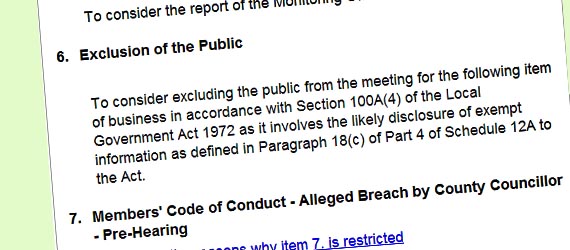
Item number seven on Tuesday’s agenda, is titled:
Members’ Code of Conduct – Alleged Breach by County Councillor – Pre-Hearings
And that’s all I know, and potentially, if it’s decided that the un-named councillor doesn’t have a case to answer, that might be all the public will ever know.
The reason? Because the immediately preceding item, number six on the agenda, is:
Exclusion of the Public
To consider excluding the public from the meeting for the following item of business in accordance with Section 100A(4) of the Local Government Act 1972 as it involves the likely disclosure of exempt information as defined in Paragraph 18(c) of Part 4 of Schedule 12A to the Act.
A link is provided under item 7 which leads to this page:
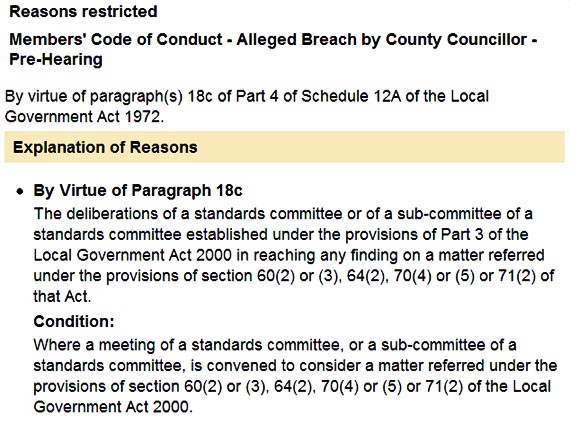
Following a chat I had this morning with ‘a man what knows everything,’ I understand, as the above demonstrates, that it is only the deliberation of the Standards Committee that is supposed to be considered for being held behind closed doors – I.E., the allegations, evidence and representations should be heard openly, and only the decision-making process can be held in secret.
Perhaps I’m being presumptions and all will be considered in public before the committee goes off to decide whether anonymous has a case to answer, but somehow I doubt it. Why else would no other details be provided on the agenda? It doesn’t even include whether or not an Ombudsman or Monitoring Officer’s report is going to be presented to the meeting.
The agenda for the meeting was published only this morning so it’s probably understandable that the gossip mill is still rather quiet. I genuinely have absolutely no idea who the ‘County Councillor’ is. It did cross my mind that it could be an old case relating to an ex-councillor, but I can’t see it myself.
8 Comments...
Have your say...
 Check out and 'like' my Facebook page ↴
Recent posts…


The exclusion of the public is, of course, not mandatory but a matter for the committee to decide. But knowing PCC they are unlikely to do other than the Proper Officer’s bidding.
The veil of secrecy is compounded by the fact that the catch-all reason given for exclusion (para 18c) contains a whole list of reasons why it could be relevant but not a clue as to which provision it relates to. For example:-
60(2) refers to sitting members whilst 60(3)refers to previous members.
Unfortunately, the Monitoring Officer, Mr Harding, was not even prepared to tell me in which category the complaint fell. Whilst we know that the Ombudsman has recently investigated complaints against Cllrs Lewis and Wildman, there are possibly others that this refers to. Watch this space.
As I understand it, the system works a bit like the Magistrates’ Courts where the evidence is heard in public and the members then retire i.e. exclude the public, while they deliberate on their verdict/conclusion.
I have it on good authority that it might be some young whippersnapper 😉
Young whippersnappers are few and far between on PCC so that narrows the field somewhat!
The problem is that members of the laughably-titled Independent Plus are so in thrall to and dependent upon Council officers that if an officer told them that it was raining fish and chips, they’d be outside with the salt and vinegar in two seconds flat; so, the chance of proper public scrutiny of elected members of the governing group is practically nil.
I suspect it would be different if it was a member of the awkward squad who keep on pointing out that the emperor not only has no clothes but is paid more than the PM.
I find it incredible that this committee can even consider meeting in confidential session after my ordeal at the hands of this committee. Remember that two members of the committee are party animals, I would suggest that no councillor should be involved in a process of possible censorship when discussing members of their party or opposition party members.
It is also crucial that members of the committee have a knowledge of the law or receive proper legal advice from someone other than a Pembrokeshire County Council employee.
I agree Malcolm, and as it stands, if this committee decides at a preliminary hearing that a councillor does indeed have a case to answer, that same committee membership will sit on that case again when it returns.
If it can be said that it has pre-judged the matter, whatever it is, has it not already “fettered” its discretion, whatever the decision? Unless of course, it can be argued that it hasn’t yet heard from the accused.
Sounds a bit like the CPS which determines the chances of a sound conviction before trial.
What has been the impartial officer’s role in this? Presumably some “evidence” has had to be collated and reported.