

Monday, 18th November, 2013
Opportunity shocks
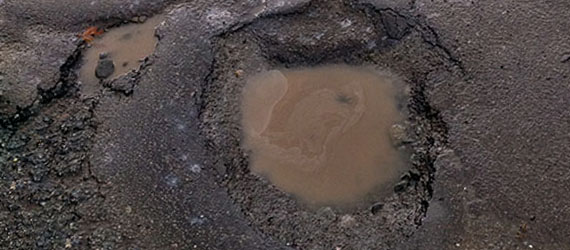
A discerning reader of the finest of the county’s political blogs recently sent the author some interesting photographs he had taken.
And then the author passed them on to me! It was rather appropriate because I had loosely touched on the subject matter myself in the comments of a recent article. Another reader, by the name of Weasel, said that I should create a new section of my website to publicise the “insane, ridiculous, contradictory, or just plain laughable quotes” from councillors.
Weasel offered up a comment cabinet member Cllr. David Pugh had made supporting the cabinet’s recent decision to increase car parking charges, where he also claimed that the chambers of trade were in favour of ‘keeping’ car parking charges as they “encourage change over.”
I duly toddled off the Western Telegraph website, where, sure enough, I found an article in which Cllr. Pugh said just that. Maybe he was misquoted, but it did seem a peculiar thing to say, and I noticed it earned him a lot of stick in that week’s Pembrokeshire Herald ‘badger column.’
In the same Western Telegraph article, Weasel overlooked another worthy comment, and that was from council leader, Cllr. Jamie Adams.
A farmer, he’ll surely be familiar with the perils of foot-in-mouth disease. His comment sought to explain what the motorist, or as he might put it, ‘customer,’ gets for their money.
It’s not stated whether he said the following during the course of the cabinet meeting discussions, or directly to the reporter, but on the hike in car parking charges, and with my emphasis underlined, the WT reported:
Leader Cllr Jamie Adams said parking is a “discretionary service” and the council’s charges “remain considerably lower than in other counties” and than those imposed by the National Trust and National Park.
“What users are looking for are safe, well maintained parking opportunities,” he added.
“We have a duty to ensure, again, that these services are provided but at a cost.”
Now, I don’t know about you, but if my car didn’t have fancy parking sensors and I didn’t want to run the risk of scraping my bumper on the concrete columns in the multi-storey; if I asked a passing member of the public if they would be so kind as “to see me back into this opportunity,” they would be liable to give me some funny looks.
In a similar vein, the highly competitive American-Soviet ‘Opportunity Race’ of the 1950s and 60s just hasn’t got any ring to it, and, in the week which marks fifty years since his assassination, the Cape Canaveral John F. Kennedy Opportunity Centre doesn’t quite cut the mustard either.
With Cllr. Adams’ ‘parking opportunity’ sound byte in mind, the reader wrote in to share his photos with the Pembrokeshire public. He says:
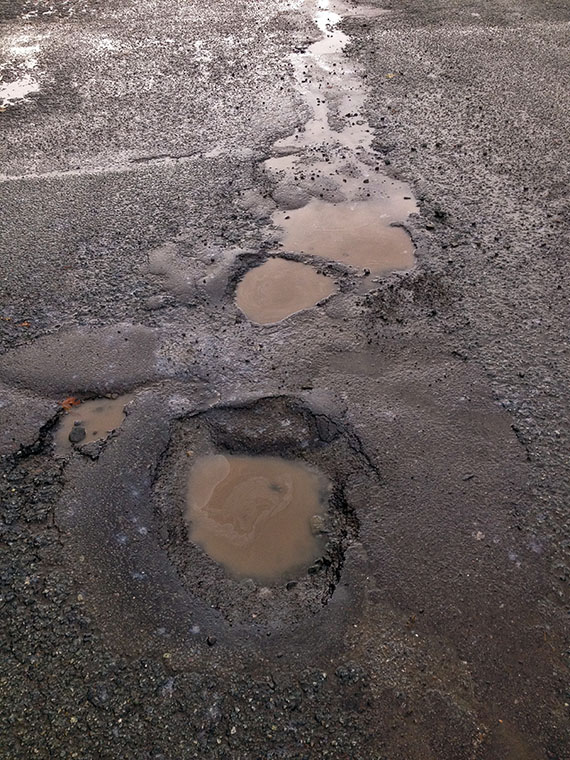
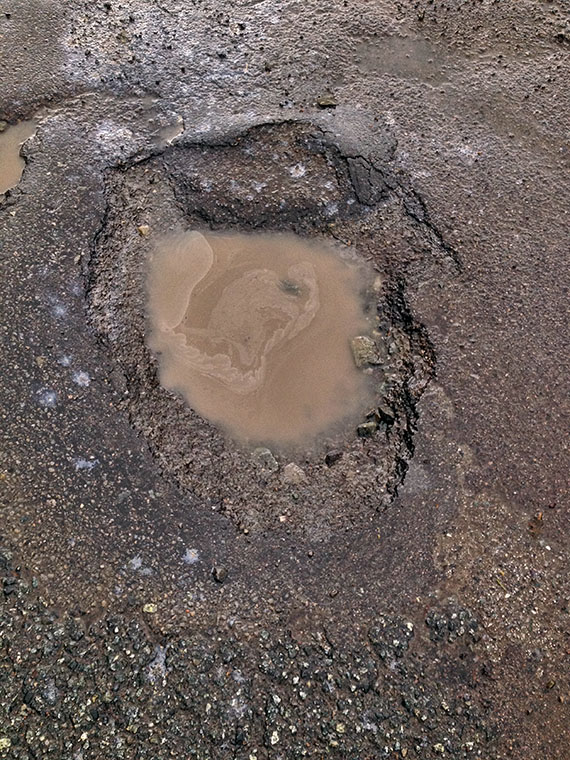
I thought I’d send you some photos of a “safe, well maintained parking opportunity” that I have each morning when I park in Castle Lake car park in Haverfordwest, for which I currently pay £1.30 per day, soon to rise to £1.50.
It’s right in the middle of the road about 30 yards into the car park.
When asked for a comment on whether it thought this represented a “safe, well maintained parking opportunity”, my front right shock absorber said “Ouch!”
If, in the coming days, I also receive a nasty anonymous letter with a County Hall postmark telling me my blog is a load of tripe and I’m a “waste of opportunity,” I’ll have my suspicions.
Click to read the update!
21 Comments...
Have your say...
 Check out and 'like' my Facebook page ↴
Recent posts…


At least the potholes are ‘sustainable’, another modern buzz word.
One of the joys of having council meetings filmed is that it is very easy to verify what councillors actually said in council meetings.
Opponents of filming in Carmarthenshire put up a whole host of specious arguments to try to stop the cameras, but the one which always amuses me is that they are worried about being quoted out of context.
What the filmed record in Carmarthenshire shows is that they have much more to fear from being quoted accurately, in context.
I’m hoping to bring out a Christmas annual of the best bits next year.
A revolution was announced at the Older Persons’ O&S committee when it considered revised charges for non residential care. Officers graciously offered that the results of the consultation process would be submitted to O&S BEFORE Cabinet took its decision based on officers’ advice. Thus an O&S committee would be in a position to offer its thoughts before Cabinet reached its decision!
The report agreed by Cabinet for consultation involved increases in charges with a potential increase of income of some £800,000.
At the O&S it became apparent that actual income would depend on each individual’s care needs and their financial assessment, and consequently the additional target income may not be achievable and may not bear any resemblance to reality.
This could be regarded as a guide to how the Council is approaching “planned” budget reductions. Quite how Cabinet reached its decision on the basis of incomplete advice and information on how the proposed charge rates would achieve the income level proposed is not clear.
Put a report in front of the Cabinet and the rubber stamp comes out. Are they up to the job?
The justifications for all increases in charges need to be subject to close scrutiny.
But I don’t pay to park in National Trust car parks. I’m a member and park for free. I pay my Council Tax to Pembs CC which includes car parks… and guess what… I pay them even more to park. If you then add Cleddau Bridge tolls, I am then sure I am paying higher “Council Tax” than say Carmarthenshire or Ceredigion, where they have no toll bridges.
Too many smokes and mirrors are used to keep Council Tax down. Why not just scrap the tolls and add the costs of the Cleddau Bridge to our Council Tax bills to get a true Council Tax figure? As far as I am concerned, it’s no different to any of the hundreds of other bridges there must be in the County. And it just looks like a road…
I always thought that all roads including bridges were financed out of the road fund license fee. The fee structure on this bridge came about I believe because of the decision of Pembrokeshire County Council to build the bridge.
I am sorry Andrew, whilst I would wish it to be financed out of the roads budget I am afraid you cannot expect those who do not use the bridge to pay for it through their council tax.
Malcolm is correct in so far as the decision to build the bridge was a “local decision” by the former PCC and was to be self financing from toll charges on bridge users.
From the outset it was recognised that an annual operational deficit could arise and that this could only be financed from the Council Tax, “other monies of the council” as described in the Act.
The Local Act of Parliament governing the bridge provides that annual deficits must be accumulated and charged with 10% interest at half yearly rests.
The total Accumulated Deficit at 31 March 2013 stood at £56,887,000. I would suggest that this debt is never realistically going to be collected from bridge users and repaid to Council tax payers.
The 2012/13 bridge deficit, calculated in accordance with the Act increased by £5,384,000, whereas toll income amounted to £2,897,000. According to one accounting method the bridge made a trading loss of £4,274,000, yet still was able to “pay” the Council, (ie taxpayers) £1,893,000 to reduce Council tax. We have the lowest Council Tax in Wales.
As long as this debt remains within the Council it apparently does not exist, and the accumulated deficit can continue to rack up. However, if somebody outside the Council wishes to take over the bridge, the Council is on record as requiring the £54m.
In the real world, it would appear that the accumulating debt comprises of a core real money debt, to which overbearing notional interest charges are added. Incidentally the bridge is valued at £24m, with an outstanding capital debt of £2.8m.
Anyone want a bridge?
If you’re a member of the National Trust then you pay a membership fee, therefore, henceforth, etc you DO pay to use their car parks and do NOT park for free.
You member!!!
Will someone please reassure me that the comment above made by Malcolm Calver on 19th November is actually a “wind up” or “mickey take”…roads funded out of the RFL? Don’t pay for a service/facility through Council Tax unless an individual uses it? Barking!
I note that Paul Davies AM was pictured in the local press this week supporting this taxpayer/ratepayer funded body. I note also from his website that he claims to be “putting Pembrokeshire first”, I would suggest that perhaps instead of supporting the “little green buses” he should concentrate along with other elected AMs and MPs of getting rid of bridge toll.
God help us if the assembly gets tax raising or tax variation powers.
Malcolm Calver said that “I am afraid you cannot expect those who do not use the bridge to pay for it through their council tax”. However, when we moved into our house on a new build estate we didn’t have street lighting for almost 5 years. When I contacted the council to ask for a reduction in council tax, I was told that we pay to cover street lighting for the whole of the county, not merely our street/property. Same difference???
Surely the bridge is now of wider benefit to the County than just bridge users. It separates elements of the newly announced enterprise zone, it is now a vital link between the north and south of the county and possibly the WG Strategic Transport network. WG did a short time ago consider bringing it into the Trunk Road system.
Originally the Bridge was considered as a local transport issue in the context of national GB transport considerations.
John Hudson raises a point about the Cleddau Bridge. As everyone will know it collapsed during construction which resulted in a very significant increase in cost.
It was constructed under a law which stipulates that estuarial bridges must be financed from the levy of tolls. When Nicholas Edwards became Secretary of State for Wales, he did his very best to obtain the revocation of that requirement. He failed to achieve that but agreed that the loan to Pembrokeshire should be free of interest charges, a very big concession to his then constituency. Without that help the toll charge would be much higher than 75p which frankly is kept much lower than a commercial rate.
Whilst there is no apparent reason why estuarial crossings should be treated differently to any other bridge, that is no fault of the County Council.
There are no toll bridges in Scotland.
There are no other toll bridges in Wales.
Severn bridges?
Sorry Keanjo but the Severn bridges are not in local government or WAG control.
For me the stumbling point seems to be the status of the £57m accumulated deficit. Does this exist in part or whole?
Some of it is undoubtedly real money, in respect of operational losses and redemption (of the £40m interest free loan) and redemption and interest charges on the capital build cost. However by far the largest proportion of this debt is in respect of the notional fixed 10% interest rate required to be charged on operation losses, including the on-going accumulating notional interest amount.
The Council policy is apparently to continue charging the 75p toll, set before the Council inherited the bridge. The accumulated deficit then stood at about £16m and is now £56m and is due to increase by another £5m at this financial year’s end.
The Council is naturally resistant to upsetting the position whereby it (or Council taxpayers) benefit from a subsidy of about £1.8m a year from toll income, and have to find this sum from other means.
It doesn’t seem to be in anybody’s interest to bring the finances of the bridge into the real world, which would mean re-designing the governing Dyfed Act in the light of current and future prospects of the bridge.
Not all in Wales! 🙂
David, you made a statement that there were no toll bridges without reference to who controlled them. In fact there are two more at Dolgellau and Barmouth in private ownership.
Keanjo, Not wishing to continue this thread too far, I agree that there are indeed the two, as you say, both in private ownership, so outside of our criticism of PCC.
As a quiz devotee can I set the following question:-
Which Grade One listed bridge in Wales charges fees that go exclusively towards its upkeep?
Dave, another quizzie – which grade one listed bridge does not charge nearly enough to cover its upkeep?
Incidentally if the ferry still existed, what would the charge be for a car?