

Wednesday, 26th September, 2012
UPDATE: Independent-Freemasons
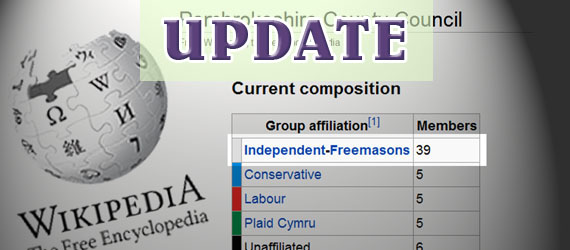
I notice that the Wikipedia entry for Pembrokeshire County Council has finally been edited to remove the Freemasons credit.
Over three weeks ago, I uncovered that it listed the controlling group of the council as “Independent-Freemasons,” and that it had been available for all to see, for months. I’m surprised it remained in place for so long after I’d highlighted it, and I expect some would like to argue that the audience of a website like mine is negligible and so nobody will have read about it.
Most visitors and contributors to websites such as mine assume that their actions and comments are untraceable and completely ‘anonymous.’ In reality things are far less anonymous, as it’s not difficult for the website owner to track who visits a web-page, how often, for how long, and exactly what they do when they are there.
Wikipedia places a lot of the information that is generally only available to the website owner, within the public domain. Because of this I can see that the anonymous person who edited the page to remove the word “Freemasons,” did so from a device that was connected to the Pembrokeshire County Council internet supply from County Hall.
It is worth noting that the County Hall canteen’s subsidised lunches are served only between the hours of 12PM until 2PM. What Wikipedia also tells me is that this edit to the article was made at 8.45am on Tuesday morning. In light of this information, I’ve decided it’s unlikely to have been made by a councillor.
9 Comments...
Have your say...
 Check out and 'like' my Facebook page ↴
Recent posts…


I found this interesting. Question – you infer that County Hall has a subsidised canteen.
(a) is this available to all councillors?
(b) is this available to all Staff at County Hall?
(c) is this available to all Ratepayers?
How much is the subsidy? What is the total annual cost to Ratepayers.
Quite frankly I object to any subsidy for food and drink to either Councillors, Staff and the like who are paid for their duties (in some cases very highly).
Why should people like myself have to struggle to pay our rates (over £1,000 p.a. in my case) only to find we are helping to feed people who are earning. The cost of the food is not the only saving they are getting – think about it – they don’t have to spend time and money (on transport) to shop for the food, but it also helps to reduce their fuel costs (they don’t have to cook it).
Reply please when you have time (or have recovered from a subsidised lunch)!
I’m not sure but I think the canteen is open to the public as well as staff. I don’t know the policy or even if there is one, but I have seen members of the public eating in the canteen who I know have sat in on council meetings and they weren’t turfed out and I’m sure you wouldn’t be either.
You raise good points on the cost saved in buying and cooking the food. I think they are like school canteen prices, and similar menus.
It is interesting that County Hall catering does not feature as a line in the Council’s estimates. I assume that this forms part of the Central Services or Corporate Budgets.
I understand that the gross cost of providing this Service would be financed by direct income from charges for meals, and that any shortfall or subsidy would be financed from Council Tax by means of internal recharges to other Council budgets for catering services provided to departments (for example £729 in 2011/12 charges to Chairman’s Expenses, probably for refreshments at County Hall for civic/ceremonial bashes).
Every year, the Chairman in post also hosts an Annual Civic dinner. In March 2012 this bun fight only cost us £1,142 for 20 covers at Bluestone. I have never understood what benefit we get for this.
The Central and corporate budgets are outside the specific remit of any formal scrutiny committee. Perhaps it is time that these budgets were subject to scrutiny by councillors.
Just spotted this article where you ‘uncovered’ the Wikipedia entry referring to Freemasons. Instead of making an industry out of parties where there are no parties, isn’t this the real issue and where the power base lies?
It’s rather telling that the only comments made refer to the County Hall canteen…
The real seat of power lies in one office holder.
The Council is required to designate one of their officers as the head of paid service. It is his duty – WHERE HE CONSIDERS IT APPROPRIATE – to prepare and submit a report to the council on matters such as how council functions are coordinated and discharged, the number and grades of staff required, their organisation and the appointment and proper management of the authority’s staff. Council is required to formally consider such reports.
At the care home fees first judicial review, it was found that officers had not been minuting meetings or keeping proper records of decisions and decision making processes. The council could not evidence its decisions. Officers were also found not to have been informing councillors fully or properly.
For some years independent Auditors had been highlighting the strong corporate management of the council as a strength, only subsequently recognising that this was too informal. Only now, after failings became evident and strong, significant external intervention, has the council’s corporate management and Constitutional arrangements been subject to scrutiny and review.
Internal responsibility for such reviews lies with a Corporate Governance Committee, (advised by senior officers), comprising the Leader, Cabinet members, Overview and Scrutiny Committee chairmen (all from the IPG Group) together with a minority of councillors from other political Groups.
Over the years, constitutional change has been sought by non IPG members by Notices of Motion. Mostly, these were refused on the grounds that that such matters were already covered in the existing but now inadequate Constitution.
Why has nobody been held to account to explain these long standing deficiencies in corporate governance? It seems that nobody is responsible for the Council’s failed corporate governance.
Is it a case of officers protecting responsible councillors and vice versa? It must be easier to deal with one compliant group of councillors than a body of unaligned councillors.
The Chairman’s recent decisions over the no confidence motion seems to be an indicator. Why refer to an elite ‘members only’ Cabinet club, all appointed by the Leader, at which the outcome could be predicted with a referral back to Council?
A vote of all councillors could Constitutionally have been taken then and there, and accord with the responsibility to ensure the efficiency of Council business.
Looking to the future what will the role of county councillors be when health and social services merge into larger regions, Regional Transport is already in the hands of SWWITCH, Education and Children’s services is under review?
Hopefully the myth that we have any local democracy will die a natural death.
How many statutory senior full time Directors’ jobs are now being shared on a part time basis? Perhaps it is not only social workers that don’t want to work for Pembrokeshire.
Sorry, I’m trying hard but failing to link the last post to Freemasonry.
Sorry Wally, I was trying to answer your question about where the real power in the Council lies.
It is only following the special audit investigation that the minutes of the unelected Chief Officers’ management team meetings have been available to elected council members. The catering point illustrates that there are areas of council activity that are still not reported, openly and transparently to our elected representatives who are meant to be ultimately accountable.
I see. But with the utmost respect, that is only half the story. Who appointed the person referred to? Ah yes, that’d be the…?
It isn’t so much about who appoints, but rather who determines policy and who directs and controls the council.
The head of paid service was appointed by a statutory interim Council, comprised of councillors from the former Preseli and South Pembs. District Councils. Following an election, Pembrokeshire County Council was formed and senior officers, appointed by the interim council, took up protected positions in the new Council.
Under the Local Government Act 2000, and the introduction of the Cabinet system of local government, senior officers oversaw, and recommended a new Constitution to Councillors, drawing on advice and guidance issued by the National Assembly. In some instances, council had to have regard to non statutory guidance. Some of these provisions have never been reported to our council, so it hasn’t been aware of its local choice discretion.
Since 2000, independent studies have been undertaken to review the new workings of cabinet and the effectiveness of overview and scrutiny, and reports on best practice examples were published. Very few, if any, of these have been reported to our councillors. Indeed, reference to one or two council reports will show that any suggested reforms to the Constitution have been stoutly resisted by both officers, and on their recommendation, IPG members.
Only now have officers and councillors been forced to consider and implement wide constitutional reform in order to strengthen the role of our elected representatives. Some of the former guidance was included in the recent local Government Measure which now requires compliance. Having said all that, in the absence of any declared strategic political policies, unelected officers have to step in and make policy recommendations for elected councillors to follow.
We don’t elect the officers, but we do have elections for councillors who are paid to make strategic policy and arrange for officers to implement it. It may be that senior council officers resent intervention by councillors with little collective policy direction, and this is why reform has been resisted.