

Tuesday, 30th August, 2016
First among equals
Wikipedia tells me that the Local Government Association is an organisation which “seeks to promote better local government” and “develop best practice” among council officers.
For those wondering, the LGA and WLGA aren’t one and the same – the Welsh Local Government Association is yet another taxpayer-funded lobbyist outfit, albeit affiliated to the LGA.
The LGA is made up of four political groups: Labour, Conservative, Liberal Democrat and ‘independents.’
Much like the majority of Pembrokeshire’s county councillors, the LGA seems to have some difficulty with the word ‘independent.’
To the LGA, ‘independent’ doesn’t mean no-party councillors but those from, among others, UKIP – with its hundreds of UK councillors.
And UKIP doesn’t qualify because it’s got the word ‘independence’ in its name.
Truth is, everything other than Labour, Conservative and Lib Dems is ‘independent’ to the LGA.
I can only assume on election to local authorities us councillors are signed up to the LGA and their email updates.
They also send out ‘first’ – their glossy periodical full of back-patting, one-upmanship and civic inanities.
Their website says this tripe is “received by 18,000 councillors and 400 chief executives monthly.”
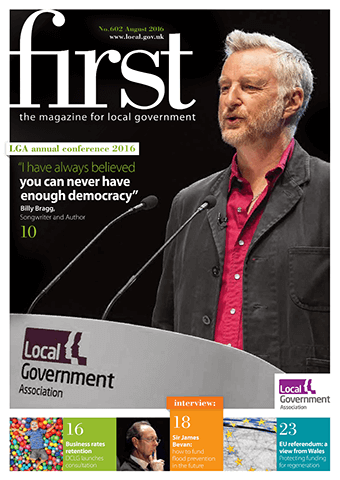 August’s front cover features the awful Billy Bragg proclaiming: “I have always believed you can never have enough democracy.”
I wish I was joking.
It reminded me of an email sent out last year to us ‘independent’ councillors titled “LGA Independent Group Elections – Special Announcement,” by the returning officer for the elections to three posts representing ‘independent’ councillors on the LGA.
This was the shocker that the LGA had “received a complaint regarding a breach of the Independent Group Election Guidance.”
The email went on:
“In particular, the complaint referred to a breach of paragraphs 2.7 and 2.8, which I set out below, in a recent newsletter written and authorised by Independent Group Leader, Councillor Marianne Overton.
2.7. Candidates must not ask Independent Group Office staff nor the Returning Officer or any other persons engaged in the work of the LGA to assist in the creation of election addresses / statements.
2.8. No candidate may incur further expenses on campaigning at any time before or after the close of nominations, nor may they send any additional material to electors by electronic or printed means.
The newsletter was sent out on Friday 26 May, within the election period, which began on Saturday 18 April with the publication of the Notice of Election.”
Clearly, the incumbent leader of the LGA’s ‘independent’ group, Cllr. Marianne Overton – who was standing for re-election – had broken the rules to enhance her electoral prospects by sending out the offending newsletter when she shouldn’t have.
The extent to which Cllr. Overton was alleged to have used LGA staff to help her re-election bid, or expenses she might have improperly incurred, were undisclosed.
But upholding the complaint, the returning officer in his email stated: “I considered this complaint with a colleague from our legal team and determined that it had merit.”
He found that Lincolnshire county councillor Marianne Overton – MBE holder and leader of the ‘Lincolnshire Independents’ opposition group at her Tory-controlled authority – had breached the LGA’s rules in her re-election bid.
The returning officer’s anticipated resolution was not to punish Cllr. Overton but “to provide all candidates with the opportunity to submit an additional statement in support of their candidacy of the same length and by the same medium.”
But, after communicating this to all other candidates the returning officer told us he: “received a further complaint that the remedy provided did not adequately level the playing field for candidates because a number of votes had already been cast,” which his subsequent investigations confirmed.
After further legal advice the whole election and all previously-submitted votes were “declared void,” new ballot papers were issued and a fresh election was arranged for the eight candidates standing for the three roles.
Cllr. Overton went on to retain her leadership position comfortably, fending off two challengers with over 60% of the vote.
Stark similarities, JW notes, to the handiwork here in Pembrokeshire of ex-councillor David Wildman and current county councillor for Martletwy, Rob Lewis.
The pair were very busy in the run-up to both the 2008 and 2012 Pembrokeshire council elections creating theirs and their colleagues’ – as well as unsuccessful candidates’ – election leaflets using council equipment, as exposed in my Partygate series.
Such behaviour went strictly against the local government code of conduct.
At the first whiff of the ombudsman’s interest in their rule-breaking deeds, cabinet member Wildman threw in the towel – he resigned his council seat and upped-sticks back to England whence he came – thus avoiding the ombudsman’s probe.
The case against Cllr. Rob Lewis, the council’s then-deputy leader, went ahead.
At the conclusion of the ombudsman’s investigation, which found he breached the members’ code of conduct, Cllr. Lewis was lucky to come before a sympathetic standards committee, whose members deliberated in private and, unusually, in the presence of Pembrokeshire County Council’s ex-monitoring officer, Laurence Harding.
For previous standards committee hearings the monitoring officer withdrew from the private deliberation room as a matter of good practice – and if his input was desired by committee members he was asked to come in by a member of committee staff.
However for ruling group councillor Rob Lewis’ hearing, Mr. Harding explained that he would be sitting in on the deliberations himself – as the usual committee staff member who acted in a clerking capacity was ‘unavailable.’
Following two withdrawals, the six-strong committee was down to four unelected laypersons to decide Cllr. Lewis’ fate, as both of its elected members – Cllrs. Stan Hudson and Tom Richards – recused themselves from sitting on the case.
It’s probably just as well for Cllr. Richards as he was a direct beneficiary of the forbidden scheme – “VOTE TOM RICHARDS” posters were among my haul of Partygate files, created on council time and equipment.
After their short deliberation the standards committee members handed down to Cllr. Lewis a paltry two-week suspension from office.
This derisory disciplinary decision even earned a mention in Private Eye’s Rotten Boroughs column – who referred to the august body tasked with upholding high standards in Pembrokeshire local government as “the amusingly titled “standards committee”.”
Holes were subsequently revealed in Cllr. Lewis’ version of events.
During a taped interview as part of the ombudsman’s initial investigation, Cllr. Lewis was asked who printed his leaflets, answering that it was commercial printer Clive James Design and Print.
Or as the transcript records: “Clive done all the printing yeah.”
When asked roughly how much he’d spent with Clive James, Cllr. Lewis replied: “Oh…£90 to £100, somewhere around there, I don’t know off the top of my head.”
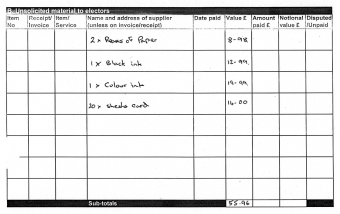 I made an appointment to publicly inspect Cllr. Lewis’ election spending return and there was no mention of this alleged professional printing expenditure like there should have been.
Not only that, but the only expenditure he did declare was £56 (unsupported by receipts) he claimed to have spent on paper and ink cartridges.
So, either he untruthfully signed his declaration that his election spending return was, to the best of his “knowledge and belief […] a complete and accurate return as required by law,” or he told porkies that he paid a professional.
In handing down Cllr. Lewis’ lenient sentence for misconduct, the minutes of the meeting record that the then lay-member chairman of the standards committee – a Mr. Ian Williams of Tenby – said that Cllr. Lewis “had been very forthright in his responses.”
“…you can never have enough hypocrisy!”
37 Comments...





Recent posts…


I have read your blog for some time, and during my period as a member of the standards committee allowed several arguable posts to pass without comment.
The standards committee is strictly limited in that it may only consider actions reviewed and reported on by the ombudsman, the quality of these reports being sometimes questionable. Had the review pursued the matter of who printed the material in greater depth, the outcome might have differed. Do not blame the standards committee for the report on which it is required to adjudicate.
It is a pity your latest blog did not quote the whole of the minuted response, not selectively choose a few words from many more.
As to the monitoring officer, his presence had no impact on the outcome. Your fellow blogger expressed some delight at the appointment of the latest representative of community councils. Are you seriously questioning his, and other independent members, integrity?
News must be in short supply, but it is the silly season.
Ian, nice to see that, despite being the silly season you stumbled on here so soon after publication!
Thank you for the detailed explanation about the process, however I think my readers can grasp what the standards committee’s role is supposed to be – even if Private Eye thinks it’s “amusingly titled!”
I’m not sure what else you think you said that I could have quoted to show you in a more favourable light.
Maybe it was the bit of your ruling where you said that ALL councillors “must be provided with clear rules governing the use of IT resources and facilities,” – as if to suggest Cllr. Lewis was a victim of ambiguity in the rules.
This, despite the fact that the members’ code of conduct and guidance is expressly clear in forbidding the use of council resources for party-political purposes – even as far as emphasising that particular care must be taken at election time.
I’m delighted to hear that Mr. Harding’s presence had no bearing on your leniency, but the fact remains that you, as chairman – presumably supported by your fellow standards committee members – handed down the two-week suspension.
You don’t seem to understand that any doubts over the sentence’s suitability are relative to the established facts before you at the time, and not developments that I may have subsequently written about on my website. Your hypersensitivity on this point is as if you think I’m criticising the standards committee for not possessing a time-travelling machine!
It is a clear fact – as stated in my post – that after the case’s conclusion, I unearthed the holes in Cllr. Lewis’ evidence. Not before, not during, so your command: “Do not blame the standards committee for the report on which it is required to adjudicate,” misses the point.
Again, the suitability of the sentence you handed down for Cllr. Lewis’ breach has no bearing on whether he lied to the ombudsman’s caseworker or the election office, and I’m afraid I really don’t understand your reference to my “fellow blogger” and his views, or see their relevance to anything I’ve written.
Interesting that your comment makes no reference to the sentence you and your fellow standards committee members handed down.
Selective? Moi?
Methinks the former chairman of the standards committee doth protest too much.
As he complains about Jacob selectively quoting from the minutes, here is the complete record of the standards committee’s decision:
First, the length of time it took to investigate the case is irrelevant.
Second, as Jacob says, the final paragraph has the flavour of excuse-making in that it suggests that Cllr Lewis’ actions arose, at least in part, from a lack of precision in the rules regarding the use of council computers.
In fact, the rules are perfectly clear.
As the minutes also record:
Regarding Cllr Lewis’ “forthrightness” I would refer to
his email to the Ombudsman (see here) in which he none too subtly tries to shift the blame onto Jacob by alleging that the Partygate files were “stolen information which was illegally obtained” from his computer.
And Cllr. Lewis’ claim that the printing of invitation cards to a forthcoming IPG meeting fell within the definition (above) provided by the Monitoring Officer is simply laughable.
These cards – inviting newly-elected councillors to a meeting where it was hoped they could be persuaded to sign up to the non-political political group – were handed out at the election count.
So, as the newly-elected recipients of these invites were yet to join Cllr. Lewis’ party, it stands to reason that these were not communications between members of “the same political group”.
It would help those of us who are not privy to all the allegations of political chicanery that goes on within it, if we knew the political composition of the committee that reviews the “standards” of our county councillors.
And, what exactly does Cllr. Ian Williams mean when he writes that “the quality of these reports [by the Ombudsman] being sometimes questionable”?
The standards committee’s prior chairman was a lay-member, Goldingsboy, not a councillor.
It’s a shame he didn’t highlight his displeasure with the ombudsman’s attention to detail before his term came to an end.
He somehow managed to find it within himself to maintain his silence during his tenure, just like he was able to allow “several” of my “arguable posts to pass without comment!”
However, Mr. Williams neglects to mention he’s a regular commenter to my blog, using a pseudonym.
To Goldingsboy, I am not, and never have been a Councillor.
Independent as a member of the standards committee relies on the dictionary definition of that word, independent of the Council and any influence emanating therefrom.
To Jacob, my early view of your post was the result of receiving an email from a third party suggesting I should log in, we obviously have mutual acquaintances.
Cutting through the reheated dialogue, what exactly are you complaining of?
Is the committee corrupt, dishonest, controlled by some power within County Hall, incompetent, or just stupid?
You will be aware the Lewis hearing was conducted entirely by independent members, the Authority members having withdrawn due to a perceived conflict of interest.
As to the minutes, you will know they are not a verbatim record of events, as several examples from County Council Members Meetings can testify.
Turning to the ombudsman, his report in this case failed to uncover one particular issue, which may have led to a greater depth of inquiry had it been pursued.
In his defence, he believes local staff were more concerned with tracing the root of the leak than in pursuing any breach of the code of conduct.
With regard to the comments on use of IT, these related to a supplementary advice note issued by the in-house IT department, which was considered less than adequate and has, I understand, subsequently been revised and made unequivocal in its advice. Recommendations such as this are part of the remit of the committee.
I shall comment no further on this matter.
Maybe the “Standards Committee” should take a bit more interest in how poor the standards of behaviour are at PCC.
The public is sick and tired of taxpayers money being squandered and the wilful disregard for good governance by the elected cabal and the in-house staff.
In any private company criminal proceedings would result from the shenanigans we have seen in the recent past. Would the outcome have been the same if Jacob Williams or Mike Stoddart had been charged with the same offence as Councillor Lewis?
It’s plainly obvious they would have been railroaded out as they keep highlighting the wrongdoings by your colleagues, Mr Williams.
You should have got your Standards Committee to be pro-active instead of hiding behind poorly written instructions from your incompetent staff.
Perhaps, if we are now using a dictionary for definitions, we should insert the word ‘high’ before standards.
This may then change the whole meaning of the ‘Standards Committee’, as it would appear that some are applying their ‘own’ standards.
It is not enough to be honest, one needs to be SEEN as honest too.
Or am I just simplifying the issue?
I wonder if anyone is able to (further) enlighten me as to how Mr Williams came to occupy his place on the Standards Committee, and what particular skills or qualities he possesses that justify such an appointment?
Is it ever going to end?
I note that the dictionary definition of ‘RECKONING’ is: The avenging or punishing of past mistakes or misdeeds.
It is at hand, next May.
From the above comments it appears the rules are clear and have been broken.
The sanction imposed by the Standards Committee of two weeks’ suspension appears a small deterrent for breaking these rules, even with the information and remit they had at the time.
Surely when the new information came to light the Standards Committee should have a process in place to revisit the case and act with a more appropriate sanction that would definitely deter further rule breaking.
Sorry, but what “rules” do you need to know that using the council’s computers for election purposes was and is wrong?
John Hudson is right. It’s a bit like saying that the 9th Commandment has “a lack of precision”.
I have experienced the shenanigans of Cllr Rob Lewis l and therefore nothing he has done in the past surprises me.
What he does in the future is of more concern and the short ban will only encourage him.
Watch him like a hawk Jacob!
Following the Cleddau Bridge financing report, several councillors expressed doubts about the legality of continuing the council’s custom and practice of using annual surplus toll income and applying it to county wide highways expenditure. Even with the Leader’s assurance that the Council was “at liberty” to do so.
Councillors sought strict legal clarifications that were not forthcoming.
This is another set of rules (the Dyfed 1987 Act) that some at the council find difficult to interpret.
This debate is very interesting and there seems to be little doubt that Councillor Lewis deserved a more severe penalty but, to my mind, this pales to insignificance to virtually losing £1.75 million of council taxpayers’ money on the Bluestone project and many thousands more in grants to failed commercial projects.
There is also the outstanding matter of the Pembroke Dock fiasco. When will we get proper explanations on these matters? Where does the responsibility lie? What disciplinary action is proposed for those responsible for wasting our money?
You have to wonder how much the council’s officers helped finesse an argument to provide a smokescreen of “confusion” after the event.
It is not unusual for this to have happened in the past, but we now have a new culture, or so some would have us believe.
And I thought Orwell’s ‘Animal Farm’ was fiction. My mistake, it’s based on local (and national) governance.
As long as man has greed, we will always have councillors acting in their own interest. I cannot see that behaviour changing, regardless of new ‘names’ given to the differing parties.
I just hope that my ‘price’ is somewhat higher than those who are supposed to represent us at County Hall.
Perhaps, John, it’s the other sort of culture and the virus persists, indeed, is gathering in strength.
In the rush to “save” the council money (in other words us, who pay council tax and direct fees and charges for the services we use) the council is looking to get services off of its books and out of its hair.
With the leisure and culture proposals, (prepared at extra cost by external consultants) it is looking to set up arms length bodies with responsibility for providing and running services.
It is likely that the agreed form of body will still be reliant on a council subsidy to continue providing services. Set up behind a wall of legal independence, the new body will have no say on the level of financial support the council decides it can afford.
Put simply, the 2015/16 Leisure Culture and Related Services budget spent £11m, received some £5m income and met the shortfall of some £6m as a charge on our rate bill.
At the moment elected councillors are supposedly in control. It is proposed that the council determines the type of separate legal entity (after due consultation of course) that will provide services in the future. It will also appoint the individuals (trustees) who will run them if necessary.
We will not be able to exercise any influence or control in the future as the services will be outside a councillor’s remit and therefore outside of democratic control.
The main selling point of this appears to be that by a legal “fiddle” on business rate relief and VAT, the consultation reveals that a maximum saving of some £0.7m could be saved, which would reduce the 2015/16 actual deficit to a mere £5.3m. Plus of course, the council would then be free to determine the level of subsidy it provides to the new independent body, and blame it, for the level and quality of service provided.
Is this the value put on democracy in the independent state of Pembrokeshire?
In advance of the consultation outcome (a foregone conclusion surely), it would be useful to hear the views of others. Jacob, and other councillors cannot possibly comment for fear of being charged with predetermination and/or predisposition.
(I declare an interest as a user of Haverfordwest Leisure Centre).
We continue to have the lowest council tax in Wales, supported by the £1.8m subsidy from the surplus annual Cleddau Bridge toll income thanks to bridge users.
Ivor, does this quote from Animal Farm ring any bells?
That’s exactly my point Mike.
Perhaps we need to focus on reducing the size of the trough, as that should ensure that the number of pigs who can have their snouts in it are reduced!
Or, in other words, the ‘food’ in that trough can be given to those that actually NEED it, rather than those who ‘WANT’ it…
Replace ‘pigs’ with ‘IPPGs’ and it could be minuted in the next council meeting.
Even if one of the other independent “animals” could think of a resolution, how can they get support for it?
The majority pigs would vote it down, after officers had written a report condemning it, or forgotten about it or kicked it into the long grass.
I still do not see how we are to get to know about “policies” when we go to the next election to vote for a collection of independent or no name candidates with no collective policies.
Hi John, I understand that’s the reason you’ve previously said you were an early supporter of the Pembrokeshire Alliance, but I don’t see the options being an administration like we have now with the IPPG’s post-election coup, versus an administration elected on a common manifesto.
Just look at Labour, and how its 9-strong 2012 intake haemorrhaged councillors to the IPPG, with Simon Hancock, Sue Perkins and Alison Lee all deciding the grass was greener on the other side.
It is perfectly possible – and I would say expected among Pembrokeshire folk – that the majority of independently-elected councillors could run the council on merit, independently.
That is to say, approaching each topic with an independent mindset, not being whipped to death, and serving constituents’ interests rather than unelected officers’ interests.
The voting patterns would be most interesting as the administration would have to win the arguments in the council chamber, instead of simply acquiescing the votes.
What a thought!
An independent party dedicated to reform the existing structure of the county council with clear aims in its manifesto explaining its approach could do well in the next election.
I would suggest for a start: reduction of councillors’ allowances to £10,000 per annum for the duration of the council, reduction of Special Responsibility Allowances by 50%, an immediate review of the staff structure which should be member-led and aimed at reducing administration costs by at least 25%, such economies to be at management level, not tea ladies, roadmen and other sharp end workers.
No doubt there are many other progressive policies which should be added. Such a group would certainly collect my vote.
How can I choose who to vote for? Candidates do not have to promise anything and we could all vote for 60 different things.
This council now seems to be run by consultants. The Haverfordwest Masterplan is a regurgitation of an earlier study and plan, by the same consultants. Nothing came of that and I can’t see that PCC is promising any direct action with the current version.
The market/Library proposal was born out of recognition that all of PCC’s markets were costing money, and I think that the Haverfordwest one was so dilapidated under the “care” of PCC that the plan to get rid of it was justified by a potential unaffordable remedial works bill of some £2m. The cost of this work can now be hidden in the £3.4m cost of a new library refurbishment.
Didn’t the joint PCC/college study identify remedial works running into millions in respect of the county’s schools? Where are our councillors and what have they been doing to allow this to happen over a number of years? Oh, I forgot, we do have the lowest council tax in Wales!
The current culture services plans are also consultant-driven, arising from the PWC cost reduction plan. I noted that the consultants offered to help oversee the implementation of their favoured Trust option. This is all very well for non-political consultants and unelected officers to promote, but where is the political overlay and scrutiny before consultant commissioning takes place?
There does not seem to be any political input or representation, but perhaps this has taken place in secret member-only seminars. Perhaps alternative ideas have been put forward at these meetings but never see the light of day.
Why has it taken yourself and Mike so long to expose dubious practices in the council, it has been a long uphill struggle that is still continuing? I believe the internal audit service gave the grants matter a clean bill of health.
John Hudson, just be grateful that Jacob and Mike Stoddart have been shining a light on the dodgy practices of the council. If it wasn’t for them none of us would have much idea about how much of a cess pit it is. Keep up the good work and name and shame the culprits.
Below are two extracts from the report to the audit committee in September 2013 after I had drawn attention to what I considered to be flaws in the way the grant scheme was being administered:
And:
Similar assurances were given at the cabinet and full council meetings in December 2013 and it was not until Jacob and I produced he clearest possible evidence of irregularities in the tendering process at 10 Meyrick Street that the council was forced to act.
A detailed dossier was handed to the police on April 7 2014 and two-and-a-half years later we are still waiting.
Sorry Keanjo, but councillors’ basic salaries and SRAs are fixed by an Independent Remuneration Panel appointed by Welsh Government. This was to ensure councillors did not vote themselves unwarranted salary increases.
Staffing structure/resources is, by Act of Parliament up or down, to the Chief Executive and even councillors cannot meddle with this if he deems a certain level of grades/numbers and pay necessary.
Councillors could look at the level of financial delegation given to chief officers/directors, which at the moment is restricted to approved annual budget amounts, and impose restrictions on spending.
For example one-off spending could be permitted, but where a proposal gives rise to a future spending commitment, such spending could be made subject to detailed report and cabinet/council approval.
The use of reserves could also be made subject to detailed report. At the moment it would seem that officers juggle overspends in the year by using reserves. A revised current budget is approved every year by council with little detail, although this is improving. Much more detail could be asked for by councillors, preferably before expenditure is incurred.
It is difficult to see that there is much financial control by elected councillors. This does not get us anywhere in the forward priorities and direction for our council.
John, surely members of a reform party could voluntarily reduce their remuneration if they gained power.
I am very surprised that chief executives have been given so much power to act without the approval of elected members. Maybe they should be appointed on a 4 year contract, renewal subject to re-election by the public.
Local authorities seemed to work much better before the advent of chief executives when the legal director was considered to be the administrative head – one way of saving £200,000 a year.
Keanjo, the recent flurry of outsourcing and external reports raise fair questions over the current chief executive’s capability for the role, but as for his chief legal officer, do you really think she’s any better placed to lighten the workload?
No, Observer, I certainly don’t but the legal heads I knew were people of considerably stronger character.
I rather fear that the “all powerful nature” of the CEO’s job as authorised by Parliament, grew out of the need to curtail interference and meddling by councillors in officers’ appointments and working.
Much the same as housing allocations have been removed from councillors’ control. I think this stems from 1972 or ’89.
Subsequently, other statutory officers were given the overriding power to require councils to provide them with the resources required to do their job.
CEO “protection” from unwarranted and inappropriate interference/influence by councillors was also given, by way of the formal statutory dismissal and appeal process.
Somehow PCC, by a narrow majority, were able to get round this formal process by the council approving Jamie’s mutual agreement on the grounds of potential cost saving.
I understand legal advice was given on this matter, although I am not sure that councillors were ever allowed to see it, I do not think it was available when the decision was taken.
The council has to pay the statutory salaries to councillors. Once in their pockets, it is up to them whether they donate to charity, or not.
The system all rather depends on all sides and everyone acting with truthfulness, integrity and strict legal observance.
On an unrelated matter, but relevant to PCC and its employees’ contempt for the county’s money spinners, this article from the Tenby Observer:
http://www.tenby-today.co.uk/article.cfm?id=107434&headline=Importance%20of%20tourism%20to%20Tenby%20reiterated§ionIs=news&searchyear=2016
You have to question what Alan Turner actually does and why is he paid so handsomely?
Flashbang, you could also ask whether tourism departments in both the National Park and the County Council could be amalgamated or indeed whether both should not be disbanded and the tourist industry encouraged to run their own tourist office in liaison with the Welsh Tourist Board. Some hefty savings there!
There may be a tourism manager’s job going under the proposed Culture and Leisure Trust, to be appointed, after consultation of course.
Whether this proposed Trust will be any more responsive is open to conjecture.