

Thursday, 30th July, 2015
Westley winds of change
The summer’s grass court tennis season is well over and Wimbledon is but a distant memory. With such time since my last post I’ve heard that some are even wondering if the autumn’s US Open is going to be done and dusted before I find my keyboard. Or hoping.
As if!
A lot of water has passed over the weir afront the Kremlin on Cleddau since my last post – chief among which was this month’s new permanent appointment to the county council’s top job, no less.
The newly-appointed chief executive, Ian Westley, had been in the role in an acting capacity since the departure of former incumbent Bryn Parry-Jones.
Mr. Westley was one of only two candidates shortlisted by the authority’s exclusive senior staff committee from a longlist of six.
The longlist of six had, at an earlier meeting been whittled down by the same committee from a crowded field of over twenty applicants for the role.
Both shortlisted candidates went before an extraordinary full council meeting on 17th July for the final interview and selection process.
Apart from when the role’s £130k salary was set earlier this year, this was the first and only input all councillors had over the appointment.
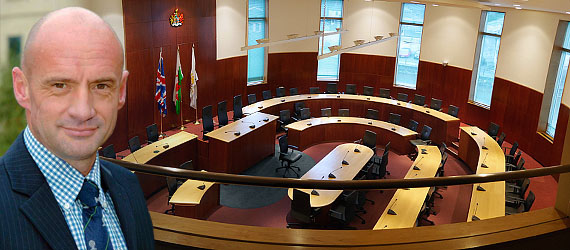
For the meeting the council chamber’s webcasting system was turned off, apart from the beginning and end.
The plug was pulled once the apologies for absence and other formalities were out of the way and the meeting was conducted in secret session, with the exclusion of the public and press.
Despite being held behind closed doors, what I can say is that each candidate was introduced separately to the chamber and was asked to give a fifteen minute presentation on his vision for Pembrokeshire.
Following which, he was asked a set question by the chairman, Cllr. Wynne Evans, then the vice-chair, Cllr. Tony Brinsden, followed by each of the council’s group leaders who asked a question of their choice.
They were the leader of the ruling IPPG party, Cllr. Jamie Adams; Labour group leader, Cllr. Paul Miller; Plaid Cymru leader, Cllr. Michael Williams, then the Conservatives’ Cllr. David Howlett followed by the Pembrokeshire Alliance’s Cllr. Bob Kilmister.
The council’s several other independent members like me, who honoured their pledge to remain independent instead of signing up to the independent party once safely elected, have no leader – as we’re not affiliated to any group.
But us members who former deputy leader Cllr. Rob Lewis once dubbed the ‘Uglies’ weren’t left out because the powers that be allowed one of us to ask a question too.
Competition among us Uglies wasn’t fierce and the interrogator from the ranks of the great unwashed, as it turns out, was yours truly.
I opted to probe each candidate on their response to the hypothetical member of the public, who, suffering from front-line service cuts and changes might look inwards at the council – with its bumper management-level staff roll – to meet financial pressures by other means.
As part of the morning’s process, each candidate was allocated an hour and a half with full council. Ahead of the meeting we were notified that if, at the end of the group leaders’ questions the 90 minutes hadn’t elapsed, other councillors could ask their own questions of the candidates up to the time limit.
Going in to the secret meeting I feared this clock-watching approach – which was ostensibly in the interests of fairness – had the potential to deprive councillors the opportunity to seek all of the information required before what is arguably the most important appointment any council can make.
I’m happy to report that this didn’t turn out to be the case. Each candidate had enough time to spare and there was plenty of opportunity for all of the councillors who wished to ask questions to do so.
Former leader Cllr. John Davies was one to grab the opportunity. I seem to remember his preamble made reference to the strengths of our special part of Wales and its future.
Cllr. Peter Stock didn’t skirt around the issue he put to each candidate. It was about the Armageddon-like prospect of the return of Dyfed through county mergers, and the Welsh Government’s ongoing radical reform proposals for local governance.
After each candidate had been seen, we went to a vote, which was taken by ballot.
Before doing so, Cllr. Mike Stoddart asked if the meeting could return to public session and for the webcasting facility to be switched back on.
It’s hard to disagree with his suggestion that the voting process – which was a secret ballot in the total absence of either of the shortlisted candidates – could in any way divulge any personal information relative to the recruitment process.
After all, this was the reason for excluding the press and public in the first place.
But disagree the legal advisor did, who was unable to answer which information may be revealed by televising the vote, which unsurprisingly consists of councillors placing their folded ballot papers into a single ballot box.
We were advised that the cameras could be turned back on to reveal the result.
I understand from speaking to Cllr. Stoddart that he intends to write about this matter on his own blog – and why he wished for the webcasting facility to be turned back on at that time. Suffice to say it was for good reasons.
Having counted the ballots, the webcast was turned back on. All viewers of the nine minute clip get to see is the start of the meeting, the exclusion of the public, and then the declaration of Mr. Westley’s victory and his acceptance of the offer.
The number of votes each candidate received was not declared.
It has surely been difficult for Mr. Westley since taking over the reins at short notice from his former boss, Bryn Parry-Jones.
The prolonged downfall of the erstwhile capo di tutti capi culminated in a series of explosive events almost a year ago followed by a protracted and, ultimately albeit not necessarily, very expensive departure.
I wish Mr. Westley well, and hope his record of public service will be memorable for all the right reasons.
30 Comments...
Have your say...
 Check out and 'like' my Facebook page ↴
Recent posts…


Same horse, different jockey. Councillors interviewing the candidates – what experience do these people have?
It would be interesting to see the presentations made by the two candidates. Cuts cuts cuts, and do nothing to the people on the gravy train.
I’m quite cynical about Mr Westley’s appointment as he appears to be cosy with the past disgraced regime.
I’ll believe the taxpayers of the county are getting a better deal when I see heads rolling and changes made.
I’d like to know why the legal department hasn’t been fired yet? They are plainly incompetent and an embarrassment to the council yet they still remain.
Now Jacob comes an interesting bit. Mr Wesley’s previous position is vacant. If it is decided to proceed with an appointment, the likelihood is that it will be offered to one of his Directors who naturally will expect a salary increase. But the ceiling which was once approaching £200,000 has now been lowered to £130,000, so what can the new Director now be offered or will Mr Wesley recommend his post be not filled and a new management structure introduced?
Many of us recall the pension scam whereby an ever alert Senior Staff Committee approved a scheme, in some very unsavoury circumstances, whereby senior officers could take up an option and get the equivalent of Employer’s S&P Contributions paid direct as an add on to their salary.
Following intervention by the WAO, Council rescinded this decision in February 2014, before the start of the financial 2014/15.
The Draft 2014/15 accounts page 62 shows that the Council did not pay any S&P Employer’s Contribution in respect of the former Director of Finance and Leisure’s employment for April and May, when he retired.
If the option was taken up, when was it put into operation? Who approved it? Was it before or after the Council’s decision to rescind the option?
Does anyone in this wretched Council have a clue as to what goes on?
Clearly the import of budget reductions had not been recognised in the corridors of power at the start of 2014/15.
In April 2014, the Council paid an invoice for 5 PAST CHAIRMAN Sterling Silver Gilt and enamelled pendants at a cost of £184.19p each, total cost was £930.10, including carriage.
When do the great and the good wear them? I am sure that we taxpayers benefit and derive great value from this mark of honour to the dignity of the office.
I wonder if they would buy them if they had to pay for them? Perhaps the recipients have, or are required to reimburse the Council. Is the Council going to last another 5 years?
In the current state of financial austerity, isn’t it about time such gestures were a thing of the past?
John, that expenditure is outrageous!
The only time I’ve ever known the council’s past chairmen to wear their ‘PAST CHAIRMAN’ medals is once per year, at the annual general meeting.
They are very small, round, worn like a badge, and cost the best part of two hundred quid each. Whatever next?
(In case the PC brigade are on to me, there are currently no serving past chairwomen on the council.)
Jacob, correct me if I’m wrong but weren’t you one of the members who voted for the switching off of the webcast and the session to be held in secret?
Don’t worry about not having blogged for a few weeks, Bob Kilmister hasn’t blogged for over 5 months. The Pembrokeshire Alliance website is moribund.
Galf, I believe the vote was unanimous. Certainly, nobody voted against. Once the ‘interview’ process was over I don’t agree that there was any reason for the meeting to remain in private session.
But it’s not easy to do anything about it when the council’s legal officer says otherwise!
As for Bob’s blog, it was launched with the name ‘Bob on Friday,’ suggesting readers would be offered a weekly dose.
The title’s self-imposed deadline must have become too much of a burden to honour because it didn’t take long for it to be renamed without any fanfare to the highly inspired ‘Bob’s Blog.’
It soon became apparent to us blog-watchers that ‘Kilmister’s Quarterly’ would have been the more appropriate name-change.
But that isn’t the end of the story because, at the time of typing, Bob’s last post was on February 21st this year.
If he posts within the next three weeks there’s still scope for it to be given a second re-badge to ‘Bob’s Biannual’ or even ‘Bob’s Biennial’ (posting once every other year) if he can think of something interesting to write about by Easter 2017!
Kilmister’s Quadrennial (every four years,) Kilmister’s Quinquennial (every five years,) and Kilmister’s Quindecennial (every fifteen years) are other possibilities. But that would be silly.
Beggars belief that the public aren’t privy to such goings on.
These people are public servants and as such they should have no qualms about being grilled in public if they want lead OUR local authority and be paid handsomely from OUR money.
What exactly is it that we’re not supposed to be seeing/hearing? Westley and the other candidate would have done well to insist that the cameras stay on to aid public confidence in the transparency in this council.
Galf, the public were excluded under S100 Local Government Act 1972 which provides that the council may resolve to go into private session when exempt information as defined in the Act is likely to be disclosed.
I did suggest to some of my opposition colleagues prior to the meeting that we might force a vote on this issue but there was little enthusiasm for such a move and, on balance, I think this was probably one of those occasions when exclusion of the public was appropriate.
However, it is my belief that this power is vastly overused.
Some years ago, the Welsh Government amended the law to include a requirement that the proper officer should declare whether the public interest in disclosing the exempt information outweighed its non-disclosure.
It is interesting to note that, since that amendment, there has not been a single instance where openness triumphed over secrecy.
After the the two candidates had finished their presentations, I raised a point of order to the effect that the cameras be switched back on during the voting procedure, as happened during the extraordinary meeting where the former chief executive’s pay-off was approved as you can see a little after three and a half hours into the webcast at this link.
Predictably, the head of legal services ruled against this, though she was unable to specify the category of exempt information under which the power to exclude the public was being exercised.
So much for the rule of law.
I had, and still have, hopes that the Pembrokeshire Alliance – offering the opportunity of an “independent” group of candidates, with some policies to put to the electorate BEFORE an election – will have some legs in this county.
It seems that very few councillors have any policy ideas. A few notables are keen to fulfil their obligations as councillors and hold the council to scrutiny and have successfully demonstrated this against the weight of concerted efforts by an “infallible” administrative machine with proven contentious internal audit and legal advice. Their fortitude has to be commended.
Bob was the only councillor to argue the case for some alternatives for the 2015/16 budget. His proposed options were required by officers to be fully costed with alternative reductions fully costed and identified.
How different from the council’s own proposed reductions for 2014/15 which were approved on a full year basis.
Subsequently many were delayed and the full approved reductions were not achieved. Cabinet/council were happy to let officers identify and make up shortfalls without concerning themselves with the details or the effect(s) on services.
I would suggest that policy in this county is driven by the Welsh Government (e.g. school reorganisation). This is then worked up by officers into proposals and then approved with the full unquestioning support of the majority group.
If it had not been for the efforts of one councillor, the schools reorganisation would have remained a cabinet responsibility, subject only to the possibility of a scrutiny committee call-in procedure to challenge or stop, rather than a matter for full council and all councillors to have a say and a vote.
There does not seem to be any mechanism whereby councillors can effectively, collectively, promote policies for the good of the county. Just how can councillors get themselves in the position of being able to direct their officers to implement their policies?
I am given to understand that Mr Westley is well considered by staff, and a lot of positives are said of him. Mind, those with memories may recall that the former chief was well considered, that we were lucky to have him etc, and we needed to pay him more to stop other authorities poaching him, as if!
Bryn was also a lawyer and possibly more aware than most how elastic the letter of the law could be if it came to getting away with things.
At least if Mr Westley is not from a legal background, administration of the authority might not be so creative in future!
I believe Bryn also complained in the last weeks, as the kitchen got hotter by the day, that he was not a politician. Ideally the post of Head of Paid Service should not be political, but it is difficult to keep politics out of council administration and Bryn’s dapplings in council politics didn’t help.
Secure in his appointment, perhaps he can send clear signals that senior staff stay out of the political arena (legal, finance).
Also he could resolve the Pembroke Dock Grants scandal. The police are doing an excellent job of letting the long grass grow round it, but is that the solution we want, or will allow? After all the indications seem to suggest that senior officers may have more to answer than just some incompetent junior officials and an unscrupulous Irish property developer.
He doesn’t need instruction from Farmer Adams on this matter as the professional administration of the staff is now his responsibility.
John, it is very true that officers make most of the decisions without recourse to councillors. Given the sheer size of an authority and its responsibilities, that is the case all over.
The issue as much as anything in Pembs is that this is done without effective checks or balances by the council. The ruling group are a sort of secret (and not so secret) conservatives, with a few bought in defectors. (It’s amazing how many socialists can be bought.)
If an openly conservative administration had been elected, we would probably have something like we have at the moment. (Low rates, poor services.) That is all fair enough if voted for.
What is wrong is the complete lack of real debate as the paid administration also seem to be able to manipulate, if not actually control, policy.
I believe the Ministerial Board initially thought that councillors were to blame by not holding the administration to account. Despite that intervention we still seem to have a situation where many councillors might as well be carefully cultivated mushrooms (kept in the dark and fed on s***.)
Councillors Stoddart and Williams have been exceptional in their work, however it needs a strong opposition to make Pembs politics work again.
Hands up how many are happy that what is effectively a ruling group nominee getting to chair the scrutiny committee with collusion from the administration?
Those who do, if they think it’s necessary to “get things done”, then square that with the authority’s many entries in Private Eye’s Rotten Boroughs column, its creation of at least one local authority millionaire and other failings. Quite honestly there is no point in having an elected body on this performance.
The Alliance is a fine idea, however it just fractures even further a fragmented opposition. The largest group, Labour, should be doing well out of this. Cllr Miller comes across as a very able communicator and politician, yet his own members defect to bolster what should be the very antithesis of their political creed. We need to see more “team building” from him in shaping and leading the opposition.
Don’t know about you guys but my address is still Dyfed according to most businesses with the exception of one company that insists it’s Sir Penfro – doubt I shall bother continuing trying to get them to correct it as thanks to IPiG’s old guard, their insistence on taking on BPJ despite warnings and our senior council officials’ behaviour, it’ll soon be Dyfed again.
Timetraveller, I’m afraid that, in the past, the only complaint most members of the Labour Group had about the way things were done in County Hall was that it was someone other than them doing it.
That is why they (Cllrs Pearl Llewellyn, Umelda Havard, Lyndon Frayling, Ken Rowlands, Simon Hancock, Sue Perkins and Alison Lee) found it so easy to cross the floor.
No doubt, in some cases, the passage was eased by prospect of a £15k cabinet stipend, but the feeling of power that comes from being a member of the biggest group was attraction enough for some.
I had hopes that things might be different under Cllr Miller’s leadership, but I sometimes have my doubts.
Back to my old saying that we need a political party administration – at least then they would be held to account and be given proper and thorough guidance to deliver what Pembrokeshire needs. 2017 is still too long away.
There are a number of ways in which the “Unaligned” body of councillors are Constitutionally disadvantaged by not forming a recognised “political Group”. Perhaps Mike or Jacob could enlighten us.
Given the Pembrokeshire electorate’s apparent preference to elect independent or no-name candidates, it might be hoped that the council’s long awaited new constitution could recognise this democratic expression in the way it prescribes council business.
Mike has informed us of the haste with which re-elected leading IPGers rush to form a new IPG immediately after an election and then seek to recruit new councillors to their cause. The perception being for no other reason than to share out Special Responsibility Allowances, merely to provide a public front for the unelected officers’ party.
The IPG will have the controlling hand in approving the externally drafted new constitution. On past performance, this is unlikely to be an even handed democratic exercise recognising the local context of a council, made up with a majority of unaligned/independent/no name councillors.
While we have been very keen to heap criticism on officers of the council, who have been operating in a political policy vacuum, the true culprits, for the mess this council finds itself in have escaped from any direct blame.
(Leading IPG councillors over the years and their supporters, perhaps at times even aided by some contentious partial legal advice or smokescreens, have so far not been held to account).
The council’s constitution provides the only protection we have from abuses of power, by both unelected officers and councillors. That we need impartial protection has been demonstrated, as is the fact that a complacent IPG has failed over the years to recognise the shortcomings of the present constitution.
Pembrokeshire is far from the local government I knew. The policy aims of the council was determined by the leading party but had to be ratified by full council. The task of achieving these aims were allotted to committees who elected their own chairman who was not always a member of the ruling group but a person who held the respect of the committee.
The chairman then worked with the chief officer to achieve the programme. Progress was reported to the committee who had the power to accept or reject proposals. Committee reports were submitted to full council who could approve or refer back to committees for reconsideration.
Sounds long winded but the secret was the cooperation between the committee chairman who looked after the political side and the chief officer who was responsible for the management and progress of the council’s approved programme. Any political contact with the chief officer was through or with the approval of the committee chairman.
Obviously I have simplified the system but the difference with the Pembrokeshire system is that every elected member was kept informed and was given an opportunity to express an opinion. Progress on the council’s policies was achievable and certainly more smoothly than with PCC. I would add that the authorities were much bigger and with much bigger programmes than PCC.
The system of administration in Pembrokeshire was created by BPJ. It has failed and needs to be changed.
One would hope that Mr Westley’s appointment would be the new broom, however, wasn’t this guy Bryn’s deputy? He should surely have had some idea of what was going on with BPJ/Adams et al?
One would hope that this is a fresh start, however my cynical side tells me that this is just more of the same. I hope I am proved wrong.
But, Jon Boy, what else could you call the IPPG other than a political party? My biggest issue with PCC is the floor crossing that Jamie can make happen by dangling cash in front of the opposition.
Indeed, Bob Kilmister, the leader of the mighty Pembrokeshire Alliance, almost fell for it until his own party lynched him.
Surely we would be better served by a system under which no councillor can join the ranks of the IPPG or claim any additional benefit (£££) without putting themselves before their wards for a by-election, that way there would be no more IPPG by stealth.
You really don’t allow comments that rock the boat TOO much, all this rubbish you and your betters spin – it’ll be Dyfed2 in a year’s time.
Tomos, you’ve only submitted one comment to this article which, apart from making some corrections to your poor grammar, I’ve approved unchanged.
That said, there have been previous occasions where you’ve submitted poorly informed comments which I have edited to remove factual inaccuracies. Your Freemasonry conspiracy theories spring to mind!
Richie, Ian Westley has filled Bryn’s shoes since his departure, but he was one of several directors at the council at the grade directly beneath chief executive.
There is in fact a role of ‘deputy chief executive’ at the authority however for some reason the incumbent was overlooked and Mr. Westley was invited by the leader, Cllr. Jamie Adams, to deputise.
Interestingly, Cllr. Adams has previously had to admit that he has no authority to do what he did, which is another concern!
People seem to be pinning their hopes that a change in Chief Executive is going to lead to improvements. I have no doubt Ian Westley will try his best but Pembrokeshire’s problems will persist until the present system – rule by a self elected clique – is changed and this can only be achieved by the politicians.
There is little chance that this will happen before another election is held and even then the winners may well elect for the same cabinet system which is the root of the problem.
The IPG, Rosieone, is most assuredly NOT a political party. It is purely a gravy train as witnessed by the fact that all critical areas of policy are solely in the hands of the engine driver.
Goldingsboy, I hate to disagree, but, a political party is an organisation of people which seeks to achieve goals common to its members through the acquisition and exercise of political power.
Unfortunately for us and the rest of Pembrokeshire the “common goals” of this shower seem to be cold hard cash and the retention of their majority at all costs.
The frustrating thing is that as far as I’m aware only one of their number actually stood as an IPPG candidate (Rob the plod Summons). We don’t have a council that represents the votes, they all joined after convincing the voters they were something else entirely.
The same criticism can be levelled at the Pembrokeshire Alliance. What we need is a council made up as voted for…if I vote for a labour Cllr, I don’t think it too much to ask for that Cllr to remain Labour until the next election.
Never mind Tomos, you are not alone…but you are indeed correct. Open disagreement is not tolerated by the Dear Leader of this blog.
Ah, yes, the very same Nev Andrews who used to post comments on this blog from behind such pseudonyms as ‘Wally Alford,’ ‘Certifiable Wally’ and several other masks which were variations of the befitting ‘Wally’ theme.
Very open disagreement, I must say!
A bit of unfair criticism of Mr Williams I think. He cannot publish unverified truths in case they turn out to be incorrect. Remember if it wasn’t for Jacob and Mike Stoddart we wouldn’t know what was going on in PCC.
As for Mr Westley, people that I know that have worked under him says he is firm but fair, let’s hope he remembers there are 60 elected county councillors not just the overpaid ones known as the cabinet.
The Western Telegraph story at this link: http://www.westerntelegraph.co.uk/news/13584945.Council_apology_over_bad_smells_as_first_batch_of_waste_is_sent_overseas/ has commentary from Cllr. George.
I wonder if he was he referring to any of his Cabinet colleagues?
Politicians right up to Westminster seem to reserve the right to change their politics once elected, which does seem a breach of promise to the electorate.
In the cut and thrust of politics, it would probably not be a good idea to do too much about it, the electorate just having to bide their time to the next election.
In Pembrokeshire the politics of the two main parties seems to have encouraged something like the IPPG. Many Conservatives are shy of their true colours, so trade as “independents” and contribute a large contingent to the ranks of the IPPG as well as offering the nearest we will get to a political creed. Labour defectors make up enough to keep the IPPG in office, so contributing a political greed.
The problem is the complete lack of effective opposition, Labour as the largest opposition party and political opposite should be making progress instead of contributing members to the IPPG.
It means highlighting poor social services, overpaid staff and a lack of accountability. It means taking a lead with other parties to show it can work in coalition with them.
A good start may be for all the opposition candidates to nominate a joint credible candidate to stand for Camrose when or if that “conservative” seat may be up for election.